Object: to learn what it means to be a servant by looking at Philip the evangelist
Opening Questions
- What events or stories do you recall from the book of Acts?
- What is the point of the book of Acts?
Lecture
- Our mission is to imitate Christ which can be expressed in at least three ways
- Acts 11:26: …and in Antioch the disciples were for the first time called Christians.
- The word Christian means “Christ-like”
- The image is one of a mirror so when we look in the mirror we should see something of Jesus
- We look like him, he does not look like us
- Colossians 1:18: He is the head of the body, the church;
- The image is the human body
- The head determines what the body does
- We the body do not dictate to the head, the head leads us
- 1 Peter 2:21: Christ also suffered for you, leaving you an example, that you should follow in his steps
- The image is walking
- Walking has a long biblical meaning of being in stride with God
- We follow Jesus, Jesus doesn’t follow us
- Acts 11:26: …and in Antioch the disciples were for the first time called Christians.
- What did Jesus do that we should imitate?
-
- Luke 19:10: “For the Son of man came to seek and to save the lost”
- Luke 6:36: “Be merciful, even as your Father is merciful”
- Mark 10:45: “For the Son of man also came not to be served but to serve, and to give his life as a ransom for many.”
-
- Luke writes two books:
-
- Gospel—what Jesus did
- Acts—how the early Christians imitated Jesus
- Seek and save the lost—Acts 2
- Show mercy—Acts 4:34
- Serve others—Philip
-
- Philip illustrates service in several ways.
-
-
- Acts 6:1-6—he was chosen to serve tables
- Acts 6:2 serve (diakoneo) becomes deacon (1 Tim. 3)
- Fair distribution to widows/poor
- Acts 21:8-9
- Showed hospitality to Paul and company
- Raise 4 daughters who prophesied
- Acts 8:5-40
- Preached in Samaria
- Preached to the Ethiopian
- Philip serves the Ethiopian by going out of his way
- Joins the chariot and teaches
- Ethiopian is reading Isaiah
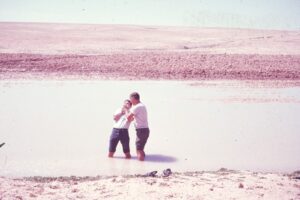
- Story: Harold and two friends traveling by car from Tel Aviv to Beersheba in 1970. Much of the trip was through the desert. Part way, we realized we were about to cross the road on which the Ethiopian and Philip were traveling. It was a desert road (Acts 8:26). We then wondered, how would they find enough water to baptize out in the middle of the desert. We slowed down and started looking. Soon we found a small pool of water. My two friends waded out to reenact the Ethiopian’s baptism. I was the photographer. The picture I took is nearby.
- Acts 6:1-6—he was chosen to serve tables
-
-
- The Ethiopian was reading this passage:
-
-
-
- Acts 8:32-33 “As a sheep led to the slaughter or a lamb before its shearer is dumb, so he opens not his mouth. In his humiliation justice was denied him. Who can describe his generation? For his life is taken up from the earth.”
- Philip started with that text and taught the Ethiopian about Jesus.
-
-
-
- This text is important.
-
-
-
- Isaiah 40-55 has four sections called the “servant psalms”
- Isa 42:1-4
- Isa 49:1-6
- Isa 50:4-9
- Isa 52:13-53:12
- The earliest teaching about service in the Bible goes back to the Pentateuch (Gen. 2:15; Deut. 10:12)
- Isaiah told those in Babylonian captivity that God would raise up a servant to lead them home and that the servant would suffer during his role.
- The suffering servant in Isaiah became the model for Jesus who became the model for Philip who becomes a model for us.
- Isaiah 40-55 has four sections called the “servant psalms”
-
-
-
- Suffering servant—Jesus—Philip—us
Discussion Questions
- Tell about a great act of service you witnessed
- Tell about a time when somebody served you
- Share how you felt when you served somebody else
- Point to some specific opportunities we have to serve
Leave a Reply