The following curriculum takes up Isaiah 1-39. It was developed by Harold Shank for the Macarthur Park Church of Christ in San Antonio and is used with their permission. Others can use this material but it is copyrighted by Harold Shank and the Macarthur Park Church of Christ.
The Way to Relate Isaiah Chapter 1
Objectives:
- The student can explain the social and economic situation of 8th century Jerusalem
- The student can explain the three images Isaiah uses for the divine-human relationship found in Isaiah 1.
- The student will understand Isaiah’s connection between worship and community ethics.
Theme:
Isaiah 1 is considered the introduction to the themes of the book of Isaiah. Thus the central theme is the nature of God and his relationship to his people and how they respond to him.
Introduction:
- Jerusalem: three main characteristics of 8th century Jerusalem
- Domestically: It was a two-class society with an oppressive ruling class and a poor underclass. The upper class had great wealth, comfort and power. The underclass lacked those qualities.
- Internationally: Jerusalem was capital of Judah, a small nation tucked in among other small nations between the two mighty powers of the 8th century: Egypt to the southwest and Assyria to the northeast. International intrigue and war will repeatedly surface in Isaiah’s writing.
- Religiously: The golden age in Israel in the 10th century was dominated by David and Solomon, the great nation builders. Civil War and a divided nation characterized the 9th century that witnessed God sending prophets to help the people draw closer to him. Prophets including Elijah and Elisha combated paganism and sought to return the people to God. The early 8th century witnessed the development of the two class society, growing international unrest and a spiritual crisis which prompted God to send the first four writing prophets—all contemporaries: Micah and Isaiah in Jerusalem and Amos and Hosea to North Israel.
- Chapter one opens with a scene which is essentially like a court case. God has the complaint; Israel is the accused; heaven and earth are the jurors. The accused (Israel) is marked all over with wounds and marks of chastisement but there are no signs of remorse. One moment the plaintiff (God) is speaking for himself, addressing the jury (heaven and earth) about the accused (Israel). The next moment, the plaintiff’s lawyer (Isaiah) is speaking for him (God).
- Be aware that in Isaiah 1 there are three images used to describe the relationship between God and the people of Jerusalem: Father-Son, Doctor-Patient, and Husband-Wife.
Learning Experiences:
Father-Son—Read Isaiah 1:1-4
- God speaks in verses 2b-3
- This passage introduces the image of God as Father and Israel as son. What other passages use this imagery? (The NT is filled with them)
- Verses 2-3: The vileness of Judah’s ungratefulness is described in brief but graphic terms. They are God’s children who have flagrantly rejected him. Donkeys know where to go in order to be fed. Oxen know their owners. Israel does not know; they don’t consider. It isn’t intellectual knowledge he’s discussing. It isn’t even “religious knowledge” he’s discussing. They are so insensitive, they are fundamentally ignorant. They don’t have the heart or spirit to know.
- The concept of God as father is first introduced in the Bible in Isaiah 63:16; 64:8
- Teachers may find it helpful to read http://www.ccfsa.org/articles-by-harold-shank/reasons-to-be-involved-in-child-care-part-2-by-harold-shank/
- How did God “rear and bring up” Israel as a father raises a child?
- What kind of child did Israel become? What is the evidence for that statement?
- See the image of a rebellious son in 1:2, 5, 20, 23, 28
- The father-son imagery is compared to the owner-ox imagery
- Have someone tell a story about how animals know their master
- What is the point Isaiah is making?
- If you wish to explore the meaning of the word “know”:
- Adam knew his wife—Gen 4:1
- Look at Hosea 4:6
- Read Harold Shank, Minor Prophets—Volume 1: Hosea-Micah, The College Press NIV Commentary (Joplin: College Press, 2001), p. 32.
- The Hebrew word “know” here goes beyond intellectual knowledge to a level of intimacy. No wonder Isaiah chose the father-son, physician-patient and husband-wife images because they all reflect a deeper level of knowing.
- Verse 4: A series of criticisms that reach deep down into the heart and soul of the nation. The people are so involved in sin that God is able to say that the nation is sinful. They’re a race of evil-doers. They have abandoned their covenant Lord and made themselves strangers to Him. They have repaid God’s kindness with rebellion; in return for love they gave Him their hate; in place of honoring Him they despise Him.
Doctor-patient—Read Isaiah 1:5-8
- In this image God is the doctor who treats the patient Israel. The same image is used in Hosea 6:1-3.
- Using several different translations, assemble a list of the medical terms used in this text. There are at least 11 physical conditions described here.
- Using several different translations, assemble a list of the words for sin used in this text (start in v3). There are at least 8 descriptions of sin described here, one of the most complete lists of words used for sin anywhere in the Bible.
- How would you describe the patient Israel? (sick, uncooperative, failure to take medication, lifestyle that exasperates the condition, sick from head to toe)
- When Isaiah drops the doctor-patient metaphor in 7-8 he seems to describe the post-Assyrian invasion.
- God plays two roles
- God makes the people sick/brings on destruction because they have violated the intimacy of the father-son relationship and God seeks to win his people back through the most drastic measures. Compare to a contemporary parent who takes drastic measures to win back the child.
- God saves a remnant of the people. He recognizes that not all the apples in the basket are bad ones, but he does remove the bad ones before they destroy the whole basket. The good ones that are left are the survivors, called the remnant in most of Isaiah. Note how even we use images to describe realities. Perhaps it would be better to talk about a basket of cucumbers (1:8).
Worship and Ethics – Read Isa 1:9-15
- Isaiah describes Jerusalem in worship.
- Solomon’s temple dominates the city
- The temple is a center of employment (Levites and priests), economics (sacrifices for sale) and activity (worship and community gatherings [according to Leviticus some of the sacrifices involved the family of the one offering the sacrifice to eat the meat after the worship]).
- What kinds of worship did the people offer? There are at least 14 kinds of worship described.
- Worship Described
- Verse 10: A terrible description of the depth of Judah’s wickedness. Had it not been for “some survivors” (vs. 9), the whole nation would have been annihilated, like Sodom and Gomorrah. There is oppression of the poor and neglect of widows and orphans. These prosperous, self-righteous and haughty people (2:12, 17; 3:16) care nothing for the needy. See, also, Ezekiel 16:49-50.
- Verse 11: These people act as though God drooled over the smell of burning animals. God has no delight in burnt offerings. Sacrifice was never intended to be a substitute for loving obedience to God or for loving one’s brother. Sacrifice apart from heart-felt submission was just smoke in God’s nostrils (cf. Isa. 65:5).
- Verse 12: The “trampling of my courts” may be equivalent to “churchgoing” today. Is it a church building full of people that God wants or a life of submission? God isn’t against “worship,” but He’s against anything that is used as a substitute for living service to Him and to others.
- Verse 13: God is tired of their feasts and their holy days. Their sacrifices are meaningless to Him because they are intended as a way to cause Him to ignore their lack of obedience and care and concern for others.
- Verse 15: Because of all this empty ritual, because of all this self-righteous formalism, when they prayed with hands held up, the Lord ignored them. For the hands which are held up are not holy hands (1 Tim. 2:8), but hands covered with the blood of their fellow men.
- God rejects their worship
- He does not reject it because it does not follow the rules for worship or the means of worship.
- He objects to their worship because their community ethics permit injustice and unrighteousness to exist.
God’s Solution – Read Isaiah 1:16-20
- In rejecting their worship God responds with instruction (1:16-17). What does God want them to do? There are at least nine commands (imperatives).
- He calls them to change the way they conduct community affairs. Verse 19: He doesn’t wait. He puts His offer right out there on the table. He wants them to live! He has no pleasure in the death of the wicked (see Ezekiel 18). Renounce the evil of your ways! Here is the plaintiff in the court case offering the offender the chance to get it all ironed out
- He calls for repentance. God is willing to work with his people, but they must cooperate.
- He tells them that their sins can be removed. Their sins involve the oppression of the poor and their selfish living. Isaiah will go into great detail about these sins in Isaiah 2-3, 5, 10.
Husband-wife – Read Isaiah 1:21-31
- In the last portion of Isaiah 1 we return to metaphor, this time using husband-wife. Once upon a time Jerusalem was faithful, v. 21a, but now she is a harlot, v. 21b.
- Verses 21-23: Like a prostitute who wears glass beads instead of real gems, everything about Judah has deteriorated. The beauty has gone from a lovely and faithful wife and what is left is an old hag who prostitutes herself (vs. 22). Honest men, here, cannot be found. They are all high class prostitutes selling themselves to the highest briber (vs. 23) and in court they make no favorable decisions in respect to the orphans and widows.
- Isaiah 1:23 drops all images. List the kinds of activities that tore at the fabric of the community in Jerusalem. There are at least nine negative activities taking place in Isaiah’s Jerusalem.
- Jerusalem was once the faithful wife of God practicing justice and righteousness.
- The earlier days of justice are described in 1 Kings 3:7-12, 16-28; 10:9; 2C 19:5-10.
- Archaeological discovery supports this claim by showing that in the 10th and 9th centuries B.C. all of the houses in most Israelite villages were the same, the classic four room Israelite house. Occasionally some cities had a larger dwelling for a government official. However, by the 8th century the archaeological record shows a divided community with one section composed of small single story mud brick houses while another section had multi-storied cut stone homes.
- But in Isaiah’s day, Jerusalem had become much like an unfaithful wife. No longer content with God and his call for a community of justice and righteousness, the elite now followed a kind of consumerism of focusing their lives on wealth, power, and comfort.
God now calls on Jerusalem to return to Justice and Righteousness
- Justice refers to a community that maintains equity and fairness.
- Righteousness is a one word summary of the Golden Rule: Do to others what you would want them to do to you.
- These two words appear in Isaiah 1:21; 26; 27.
- Isaiah uses other images to explain his husband-wife image. The other two images are:
- Jerusalem is like impure metal or tainted silver (1:22, 25)
- Jerusalem is like spoiled wine or diluted beer (1:22)
- In two of the images, God finds solutions.
- He will make Jerusalem faithful (1:26) (husband wife image)
- He will make Jerusalem like pure silver (1:26)
- The image of oaks and gardens in 29-31 is interpreted differently by the commentators.
- Some view these verses as a description of idol worship (much like Isa 57) which did take place in places that represented luxuriant growth.
- However, others understand these verses as indications of luxurious living (as will be described in Isa 3 and 5) by the oppressive classes that ruled the city. Isaiah is then announcing that they will lose the luxury on which they now focus.
- This second interpretation fits nicely with the emphasis on Jerusalem as an unjust and unrighteous community.
Applications:
- Compare the teaching of John with Isaiah’s point about worship and ethics. 1 John 4:20 “If any one says, ‘I love God,’ and hates his brother, he is a liar; for he who does not love his brother whom he has seen, cannot love God whom he has not seen.”
- God evaluates 8th century Jerusalem by how they treat the weakest members of the community (widows and orphans). Compare Isaiah’s teaching with God’s evaluation of the Christian community in Mt 25:31-36.
- Compare Matthew 6 with Isaiah 1. What parallels are there? What differences?
- Where else in history might one find the economic disparity that Isaiah encountered in 8th century Jerusalem?
- The God of the Old Testament and the God of the New Testament are the same God. What are some passages in the NT that reflect the nature of God that Isaiah describes in these three images?
- Father-son—Jesus saying that he must be about his father’s business; Jesus praying the “Our Father”
- Physician-patient—Jesus talked about only the sick needing a physician; Jesus sometimes healed people and other times forgave their sins
- Husband-wife—Paul’s household verses in Colossians and Ephesians use this same imagery.
- How is our contemporary community like or unlike Jerusalem?
- How is our congregation like or unlike ancient Israel?
Extra Material
Worship and Ethics
- Justice and righteousness often appear together in the OT and are usually summarized into one word, righteousness, in the NT.
- Righteousness has a variety of meanings in the Bible.
- Often it seems to be a synonym for “good living”
- At times, especially in Romans, it describes how God through Jesus’ death on the cross makes us as if we had not sinned.
- Matthew 6:33 says, “But seek first his kingdom and his righteousness, and all these things shall be yours as well.” In this passage righteousness might be best understood as the expressing the same kind of expectation Isaiah was describing with his words “justice and righteousness.”
The Way of the Future Isaiah Chapters 2-4
Objectives:
- The student can explain what life was like in Jerusalem in the latter part of the 8th century B.C.
- The student will understand the role of the prophet regarding the future and the options for when his visions of the future are fulfilled.
- The student will be able to reflect on the nature of the judgment and destruction God has planned for the people with the realization that this issue will continue to receive treatment in the coming chapters.
Theme:
Isaiah 2-4 alternates between what is and what might be by using the images of people filled and empty, high and low. The prophet describes life in Jerusalem in the last decades of the 8th century by clearly indicating God’s displeasure with the injustice and lack of righteousness, his dreams of what it might be like, and his plans to make it so.
Introduction:
Review
- The opening chapters contrast the reality with the potential
- The three metaphors of Isaiah 1 express both the reality of the divine human relationship in 8th century Jerusalem and the potential of the divine human relationship.
- Father God wanted a son who knew him, but Israel was a rebellious son who said the right things but lived the wrong way.
- Dr. God wanted a patient who was healthy, but God realized that it would take drastic surgery to restore Jerusalem to health.
- Husband God wanted a faithful wife in Jerusalem but she had become a harlot. She was an impure as bad beer and unrefined metal. God still wanted her back.
- The contrast between the reality and the potential continues in Isaiah 2-4
- The potential begins and ends the section
- 2:2-4 describes Jerusalem as the hub of world instruction and peace
- 4:2-5 describes restored Jerusalem as a place of prosperity and security
- The reality includes three qualities spelled out in 2:5-4:1
- Idolatry
- Injustice
- Impending destruction [or Invasion, anticipating 5:26ff]
Learning Experiences:
The word “day” dominates these 3 chapters.
- Note these occurrences: 2:2, 11, 12, 17, 20; 3:7, 18; 4:1, 2
- There are several ways in which “day” is used in the Old Testament.
- The prophets spent more of their time delivering God’s evaluation of the contemporary world than in predicting the distant future. When they did reflect on the future, today’s reader must keep in mind that most of their future is now our past. Just as we hope for a “better day” some of which may come tomorrow or in ten years or in 25 years, so the prophets had a similar perspective. The common line to explain this feature is to say the prophets were more forthtellers than foretellers. They were “telling forth” God’s message to the people at the time. As part of God’s evaluation of their community was a message about the future (some of which is our past) that involved foretelling upcoming events.
- In pre-prophetic times the “day of the Lord” was a time when God would save, rescue, and protect his people. It might be a more spiritual version of the contemporary “have a good day.” The prophets turned the concept upside down as a means of warning the people about their uncertain future. The “day of the Lord” would be a day when God punished his people. Most of the uses of the word “day” in Isaiah 2-4 fall into this latter category.
- It is likely that when the prophets speak of the future they did not have a specific date in mind, but rather a set of circumstances that would come into place and result in realization of the potential relationship with God and in community. On the day when all the correct factors are in place, this reality will result. Those circumstances may have been in place (briefly) at different points in history. For example, the people may have had a sense having realized the potential of 2:2-4 and 4:2-6 in the time of Hezekiah (which we will study in Isa 36-37), while from our perspective the correct circumstances came together in the life of Jesus, the early church, and indeed at certain points in our own time.
The rich potential that awaits the faithful—Read 2:2-4; 4:2-6
- Despite all the talk of judgment in Isa 1-12, the destruction of the people was not a complete destruction. Note how the following versus talk about survivors and the righteous who live beyond the destruction: 1:9, 19-20, 27-28; 2:9-10; 3:9, 13-14; 4:3-4.
- There are two verses in this section that are summary verses. They bear the theological message of Isa 1-4. Isaiah 2:5 “O house of Jacob, come, let us walk in the light of the LORD.” And Isaiah 3:8 “For Jerusalem has stumbled, and Judah has fallen; because their speech and their deeds are against the LORD, defying his glorious presence.”
- Note the common metaphor of walking.
- Think of other biblical uses of walking (Mic 6:8; John 8:12; Rom 6:4; 1 John 1:1ff).
- The Hebrew word for “walk” is the root from which post-Christian Judaism coined their term for “ethics.”
- To those who “walk in the light of the LORD” the future is exceedingly bright. There are at least 8 qualities of that future (for the people in the 8th century) in 2:2-4 and 4:2-6.
- Jerusalem will be a central focus of worship
- Jerusalem will have a world-wide influence (continuing the world-wide focus of Gen 12:1f and Ex 19:6) and anticipating the “go into all the world” of the great commission. Evangelism has its roots here.
- The word of the LORD will go out (note the reference in 1:10)
- World peace (anticipating the “prince of peace” in Isaiah 9)
- Agriculture will flourish—all will have enough in contrast to the contemporary Jerusalem (and also our contemporary world situation) where some had enough, but many did not.
- The people will be forgiven of their sins. Note the word for filth is also used of vomit and fecal material (28:8; 36:12)
- Jerusalem will be a place of safety (using two metaphors of the wilderness wondering and a new image of a pavilion or canopy)
- These circumstances all coincide rarely in human history, but they do occur. Consider how the people in the following texts may have sensed the reality of this potential relationship with God.
- Isaiah 37:30-38
- Luke 7:22
- Acts 4:32
The unfortunate reality that persists in human communities—Read 2:6-4:1
Idolatry—The concept of idolatry has a range of meanings from a physical object thought to be god or to represent a god (see Isaiah 44-45 for an extended use of this meaning) to the substitution of any force or interest in the place of the LORD God.
- Isaiah 2-3 focus on the second meaning
- Isaiah points to at least four such substitutions taking place in his own day in Isaiah 2:6-11
- V. 6—relying on other sources of truth
- V. 7a—relying on consumables and economics
- V. 7b—relying on military
- V. 8—relying on achievement and personally constructed sources of security (note the multiple uses of the words pride, haughty, and humbled in this chapter)
- How well do these substitutions transfer to the contemporary world? What range of idolatry exists today?
- Keep in mind that Isaiah is writing to people who go to temple, who offer sacrifice, who apparently “go to church three times a week.” What implications do you see in the people he is addressing?
Injustice—In addition to idolatry, Isaiah returns to the qualities lacking in the community life of Jerusalem. He returns to the topic in order to broaden his description so that the people understand how their community is being evaluated by God.
- His deeper description of injustice includes three aspects:
- The people who are responsible—3:1-10
- The people who are being hurt—3:12-15
- The people who benefit from the injustice—3:16-4:1
- The people responsible for the injustice in Jerusalem—3:1-10
- Identify the leaders of Jerusalem. Isaiah points to at least 11 different leaders in the Jerusalem community. See 3:1-3.
- He describes the coming chaos when God removes those leaders from their positions. See 3:4-10.
- This section speaks about the fulfillment of Isa 1:28
- The people hurt by the injustice in Jerusalem—3:11-15
- Note the use of “my people” and “his people”
- One major concern in reading the prophets is identifying who is referred to by the pronouns. Often it is not clear or the reader must carefully study to be certain about who is being discussed.
- The “my people” and “his people” are the people who are being hurt by the injustice of Jerusalem.
- God calls them “his own.” God is the “my” and “his.”
- See the same thinking in Psalm 68:1-5; Matthew 25:44-45; James 2:5
- Explore the metaphors used to describe the effects of injustice. There are at least five.
- Show a picture of an old grinding stone or millstone. What picture does the sadistic use of such a tool depict? Keep in mind that Isaiah lived in a pre-technological age. His descriptions of pain would be drawn from the things around him.
- Who is oppressed today?
- What image might they use to describe their oppression?
- The people benefiting from the injustice in Jerusalem—3:16-4:1
- Look up the words “wantonly,” “mincing” and “tinkling.” Isaiah is sarcastic and critical not because he is against the fine things women wear and the fashion shows that reflect those products, but because their luxury causes the pain of those in vv 11-15 or because they enjoy their luxury without a thought to the pain others endure (Isaiah 58 is a deeper treatment of this point).
- Vv 18-23 There is no verb and the passage has the effect of going overboard to show the depth of the insensitivity
- Fashions change with each culture so most of the items on this list are unknown to us today.
- The prophets often used reversals to describe punishment. At least five reversals are listed here associated with the repeated use of the word “instead” in 3:24-4:1.
- In the big picture of 8th century Jerusalem there were children without parents and women without husbands who lived crushed and grinding lives at the bottom of the social structure along with high society women and their pampered children who lived at the highest levels of luxury. Both groups were worshippers of the LORD, prayed to God, went to temple, and read the word of God.
Impending destruction—2:9-22
- Isaiah uses several metaphors to describe what is coming to those who rely on idols and practice injustice
- The full (2:6-7) will be emptied (3:1, 6-7; 4:24-4:1 [note the phrase “take away”])
- The high (I2:11) will be brought low (12:9, 11, 17)
- The coming judgment is described with a series of reversals. There are at least 10 mentioned in 2:12-22.
- Isaiah mentions all the symbols of strength and power in his age in 2:12-16
- These might be equivalent of symbols of strength such as the Sears Tower, the Rock of Gibraltar, nuclear weapons and titanium.
- Students of Isaiah differ on what Isaiah means by these metaphors. All of the following are suggested. The symbols of strength and power refer to
- the leaders of Jerusalem
- the defensive systems of Judah
- sites of false worship
- the symbols of affluence.
- Isaiah refers to the wealthy and leaders fleeing to rocks and caves and details their activity there (note the humor of the people giving their precious idols to the vermin in the caves rather than carry them any further) in 2:10, 19-22.
- The most disturbing part of this section is the terror passages. Note the clear source of the terror in these passages: 2:10, 19, and 21.
- Later in our study we will spend an entire lesson on the violence of God, but here we simply must be content with what Isaiah tells us.
- The critical data includes these facts:
- Jerusalem was a place of extreme human violence: 1:15; 18 (scarlet and crimson refer to shed human blood), 21; 2:7b; 3:14-15.
- To those who were oppressed, the coming terror on the uncaring ruling class in Jerusalem was a word of hope and may be the context in which we are to read 2:2-4 and 4:2-6.
- God announces the coming destruction well in advance and pleads for a change of heart: 1:18-20; 2:5, 22.
Application:
- Compare the violence of eighth century society with:
- The 20th century which has been called the bloodiest century in human history
- The city where you live
- Compare the promised violence of God with these passages:
- Matthew 25:41
- Matthew 27:27-31
- Acts 5:1-10
- 2 Thessalonians 1:7-10
- What injustices exist in the contemporary world?
- What injustices do people at Mac experience?
- What injustices to people in San Antonio experience?
- What are the clearest cases of massive injustice in the contemporary world?
- We are in the midst of the publication of a substantial number of books on the nature of God. See for example: http://haroldshank.com/preaching/thinking-about-god/
- One question that many people are wrestling with is “Why does God allow so much injustice?”
- What answers do they hear? Evaluate those responses in light of Isaiah 2-4.
- What reasons for hope might contemporary people find in Isaiah? Despite the negative nature of many of the verses, some of the most hopeful texts are found here. How can we find hope within such dissonance? Does hope always exist within dissonance?
The Way of Visions Isaiah Chapter 5
Objectives:
- The student can explain how God feels about the inequities of life in Jerusalem. Once we understand the effect of the injustice on God we can better understand God’s reasons for sending an enemy army to discipline his people.
- The student will be able to outline the kinds of behavior and thinking that God finds offensive.
- The student will see that when God decides to discipline, he acts with decisiveness.
Theme:
Isaiah 5 completes the opening section of Isaiah in which the prophet presents two different views of the ideal human community, and how God works to make it a reality.
Introduction:
- Review
- Isaiah 1-4 reveals two different visions of what Jerusalem might be like. In terms developed last week, God’s vision is filled with great potential to overcome the depressing realities of Jerusalem in the last half of the 8th century B.C.
- God’s vision includes these elements. It might be like the healthy relationships possible between a father and son, or a physician and patient or between a husband and wife. When the community does not live up to God’s standard of righteousness and justice, God’s own righteousness and justice leads him to action.
- Leaders in Jerusalem have a different vision. Their vision reflects a two-class society where the upper classes live in luxury at the expense of the oppressed class. Jerusalem leaders accept this inequity as the appropriate status quo.
- Isaiah completes his treatment of these two visions in three ways.
- 5:1-7—He uses a fourth metaphor of a farmer and his vineyard. The purpose of the metaphor is to help the reader understand God’s perspective.
- 5:8-25—He uses six woes to further identify the problems with community life in Jerusalem
- 5:26-30—He closes with poetic language to describe the discipline God will apply in order to cure Jerusalem’s ills.
Learning Experiences:
The parable of the vineyard—Read 5:1-7.
- Isaiah intends for us to experience this parable as a way of getting inside God’s heart. He does not reveal who the farmer or vineyard is at the beginning, so we are wondering as we begin reading.
- Verses 1-2: In this parable we learn of what it takes to establish a vineyard if we did not know. It takes a lot of time to do what is described in these verses.
- Some suggest that with v 3 the author is setting a trap so the wealthy in Jerusalem will condemn their own behavior. Viewed in that light, the parable is an attempt to penetrate the denial that surrounds most sinful activity.
- Vv 5-6 are parallel to previous and past descriptions of God’s discipline. If time, have the class quickly compare it with sample verses like 1:7-9, 24-27; 2:10-21; 3:1-9, 13; 3:24-4:1. This passage anticipates 5:26-30. Does the farmer overreact?
- The answer to the puzzle is revealed at the end. Israel (another name for Judah) is the vineyard on which God had poured his attention.
- Recall how God has blessed the people over time: the crossing of the sea as they left Egypt, providing food and water over 40 years, leading them into the Promised Land, destroying the armies that confronted them in the Promised Land. Over and over God did what was necessary to bless the people and see to their every need, yet they turned from his laws and worshiped idols and did every kind of evil.
- How do we stand up when compared to this standard?
- What do we worship?
- What kind of fruit does our vineyard produce?
- Now consider what he does to destroy the vineyard when it only produces bad fruit. He utterly destroys the vineyard in a very thorough way.
- Also notice how Hebrews enjoyed puns (words that sounded similar but had different meanings). Since most read this passage in English, the puns are lost. In v. 7 the words for “justice” and “bloodshed” sound similar as do the terms for “righteousness” and “cry.” It might be roughly translated as “I looked for the growth but got slit on the throat. I hoped for help but got a whelp.”
- Another point missed in English is that the word for “hope” or “wait is used three times: God looked for/hoped for/waited for grapes (3, 4) and looked for/hoped for/waited for justice (7). Vineyards take time. So do relationships. God’s action in Isaiah 1-5 may be compressed into these short chapters, but he waits years, even decades before bringing on the invasion as a means of disciplining his people. Last week we considered the terror and violence of God. This parable adds another crucial element to understanding how God acts. When he resorts to violence it is only after years and decades of pursuing alternative courses.
5:8-25—The six woes
- A woe (8, 11, 18, 20, 21, 22; compare 1 Kings 13:30; Jeremiah 22:18) was a cry associated with death and mourning. Imagine waking up to the sound of a woman walking down the sidewalk in front of your house crying hysterically. We would respond immediately, call 911, and find out what tragedy had occurred. The word woe prompted a similar response from those in the 8th century. These woe statements reflect the genre of lament. See the references to death in this section (“empty house” in 9, “grave” in 14, “decay” in 24, “corpses” in 25).
- Readers of this section would note the continuation of many of the themes of Isa 1:1-5:7:
- Knowing—1:4; 5:2, 5, 13, 19
- Vineyards—1:8; 3:14; 5:1-7; 10, 11, 22 (the last two with the mention of wine)
- Injustice—1:21, 23; 3:14-15, 23; 5:7, 23
- Agricultural ruin—1:29-31; 5:5-6, 9-10, 17
- Definitions of good—1:16-17; 5:20
- Brought low—2:9, 17; 5:14-15
- Word of God—1:10; 2:3; 5:24
- The conditions described in each woe put the people at odds with God. These attitudes and actions destroy the fabric of the human community and tear at the divine-human relationship. God who seeks to provide the agricultural bounty of verse 17 will instead bring (note the two uses of “therefore”) the agricultural and cultural devastation of vv 24-25. These are the wild grapes growing in Jerusalem.
5:8-10—Woe 1 to those who think only of wealth.
- The 9th and 8th centuries BC where characterized by the confiscation of land (1 Kings 21:1-16; Micah 2:1-2, 8-9) by which the wealthy gradually through legal (their control of the courts) means took the land of war widows and orphans and those poor farmers who through an accident or drought were forced into foreclosure. The vision of Leviticus 25 was totally ignored.
- Wealth is not condemned in Scripture (Abraham was wealthy and Jesus depended on wealthy patrons to support his ministry) but those who secure wealth unjustly and who use wealth without concern for righteousness and justice in the community are condemned. Our current name for this kind of landowner is slum lord.
- In v 8 “you are made to dwell alone” could have several meanings
- The people are homeless or landless or unemployed
- The people have taken so much land they now have no nearby neighbors
- Those who have the houses and the land will soon lose them. Their productive land will be cursed to return only ten percent of what they plant.
5:11-17—Woe 2 to those who are committed to pleasure
- This woe exposes those who indulge in luxury without concern for the community. God does not oppose finding joy or resting from one’s labors, but this woe concerns overindulgence at the expense of others. See Isa 28:1-8; Amos 6:4-6
- Three punishments are listed in 5:13-14. As with the indulgent women at the end of Isaiah 3, the punishment is linked with the sinful overindulgence. Those who had huge appetites will encounter death whose appetite is larger still.
- vv 15-17 reflect God’s divine plan which was for people to give God glory.
5:18-19—Woe 3 to those who are cynical of God.
- This woe uses the metaphor of an animal pulling a cart. Jerusalem is the beast drawing along the cart filled with sin. It suggests an intentional decision to do wrong.
- Jerusalem responds to Isaiah’s prophecies by challenging God to carry out the destruction Isaiah has announced.
- The Hebrew employs a word play on the name of Isaiah’s son to be born which he mentions in 8:1. The name Maher-shalal-hash-baz (which means “quick to the plunder, swift to the spoil) uses the same words as 5:19a.
- The people do not “know” God (Isa 1:3) but do want to “know” if he will act.
- The people say they want to “see” (5:19) but in reality they are in denial (6:9).
- Students of this passage see Jerusalem in a variety of ways
- Cynical—“Prophets have warned us before, years have passed, and the city is still standing. God is not going to destroy us.”
- Mocking—“If God is really in charge, let’s see some action!”
- Doubting—“Until we see some evidence of destruction, we’re not sure there is a God like the one Isaiah describes.”
5:20—Woe 4 to those who call evil good.
- This woe reflects a society that redefined actions based on their own self-interest and not God’s justice and righteousness. Such redefinitions lead to confusion, moral irregularities and weakening cultural foundations.
- The people in power in Jerusalem had the freedom to rewrite and enforce these new definitions.
5:21—Woe 5 to those who are proud.
- 1. This woe centers on self-sufficiency: the view that people can live without divine help, make adequate judgments and deal with any fall out.
- 2. This would apply today to anyone who thought they were already good enough without knowing God. This would be those whose pride prevented them from admitting there was anything they didn’t already know. Those who think they are better than any one else. See Matthew 14:1-12. This attitude is addressed by Christ himself.
- 3. This woe strikes at the foundation of the problems evident in woes 3 and 4.
5:22-23—Woe 6 to those who numb themselves in self-medication.
- This woe makes clear references to the Vineyard parable and to woe 2.
- The drunken heroes become famous in their exploitation of the oppressed.
- V 23 refers to how the powerful controlled the courts which they used as a means of oppression. Forms of the Hebrew word for righteousness are used three times in this verse: acquit (treat with righteousness), deprive the innocent (the poor are often called righteous in the sense that they did not cause their poverty) of his right (God’s righteousness called for all to be treated fairly).
- Result of Behavior:
- By their behavior the people have rejected God’s word.
- Isaiah 5:24b is another summary verse in Isaiah.
- Vv 24-25 list 11 responses God has to life among the hypocritical temple-going, sacrifice-offering, prayerful people of Jerusalem’s privileged rich class.
- The final two lines of 5:25 become a common refrain in Isaiah (see 9:12, 17, 21; 10:4). They take up the issue of God’s role in destruction and use of violence. As we collect data on this issue which we will discuss in a later chapter, we note here that God persists in this role.
5:26-30—The invading army
- This closing poem contains 23 qualities of the army God is sending to punish Jerusalem and many of those qualities have implications for what will happen when the army does its work. The army is not identified (heightening the terror) here, but will be in Isaiah 7-8.
- In a simile the army is compared to a lion in two different ways. (vv. 29-30)
- Isaiah will return to the metaphor of darkness in 8:22 and 9:1.
- This passage provides additional information on the nature of God’s destruction and violence which should be explored. Included are that God holds his own people accountable, he gives specific examples of what prompts such violence, that the people’s denial of the problems will not deter the punishment, that prophets are sent to teach and warn, and that it is appropriate to fear the destructive power of God.
Application:
- Many propose that Isaiah’s parable of the vineyard stands behind some of the parables Jesus told. Which ones might you suggest are linked to Isaiah 5?
- What dreams does God have for people of other ages? If God were writing a parable about your city or your congregation, what might be the conclusion?
- Compare the lifestyles and attitudes of the woe section of this chapter with people in our contemporary world. How are they the same and different?
- Compare the lifestyles and attitudes of the woe section of this chapter with people in the church. How are they the same and different?
- Woe 4 suggests that those who have the freedom and sufficiency to redefine morality often do. Consider how the following issues involve this: euthanasia, termination of pregnancy, cloning, stem cell use, downsizing, opportunity, national security.
- Contemporary culture tends to accept only the loving side of God and not his destructive side. Contemporary culture also blames God for not taking action (read destroying) the evil in the world. Are those attitudes new? How does Isaiah 5 speak to those contemporary reflections on the nature of deity?
Background Material
The parable of the vineyard
- In the previous metaphors, Isaiah moved quickly to the conclusion:
- Israel is a rebellious son
- Israel is an uncooperative patient
- Jerusalem is an unfaithful wife
- In the parable of the vineyard the conclusion of the metaphor is delayed. The identity of the main elements is described in pronouns (which change from first person to third person and back to first person) and agricultural images. The subject and conclusion come at the end. Some even propose that the love poem language at the beginning call to the hearer’s mind books such as Song of Solomon leading the reader to suppose that the parable is about a broken marriage which the grieving spouse now laments.
- Parables are generally meant to be told and not analyzed. It is our scientific modern mindset that wants to reduce everything to a point. Isaiah rather intends for us to experience the parable as a way of getting inside God’s heart.
- Isaiah’s contemporary, Hosea, acted out an allegory in which his own marriage to an unfaithful wife is compared to God’s relationship with the unfaithful in North Israel, the other half of the divided nation of Israel. Judah shared their northern border with this nation which will become a key focus in Isaiah 7.
- In both cases (the vineyard parable and Hosea’s acted out allegory) there are several elements that the reader/hearer experiences. The writer invites the original listener to pass judgment (5:3). These experiences include:
- There is the familiarity of “what more could the owner of the vineyard have done.” We share the exasperation of the farmer.
- There is the understanding of frustration or indignation.
- There is the reality of failed dreams. Isaiah places this parable immediately after the grand picture of Isa 4:2-6. It is as if to say, “This wonderful future is in store for you, why do you turn away from it?”
- Perhaps ultimately this parable aims to give God’s rationale for the coming destruction of Jerusalem. After one has done all they can at great personal cost, some other option must be pursued.
5: 15-17: Gary Smith (See his commentary, Isaiah, page 176) notes that vv 15-17 reflect God’s divine plan which was for people to give God glory.
- He argues there are two significant principles in that plan that are at work here:
- Principle 1—since people were not giving God glory, God had to humble the proud (5:15)
- Principle 2—when God acts with righteousness and justice his holiness is demonstrated (5:16)
- The two principles are intended to work together. When God makes the wrongs right it shows his holiness (Isa 1-5). When people see his holiness (anticipating Isaiah’s own vision of God’s holiness in Isa 6), God is glorified and God’s divine plan becomes reality (4:2-6)
- God’s ideal world is visualized in agricultural terms in 5:17 anticipating 11:6ff.
Lesson 4: Isaiah 6 Title: The Great Vision
Objectives:
- The student can reflect on the holiness and glory of God.
- The student can explain the call and commission of God’s workers
- The student will be able to reflect on the issues raised by God’s commission to Isaiah.
- The student will understand God’s plans for the remnant.
Preparation:
- A Bible for each student
- A copy of Isa 6 in the NEB
- A diagram of Solomon’s temple (consider using: upload.wikimedia.org/…/3/35/SolomonsTemple.png)
- A handout listing the main points of the lesson

Theme: In Isaiah 6, the prophet encounters the holy God and becomes part of God’s mission.
Setting the stage
- Review
- Isaiah 1-5 alternates between two contrasting visions of Jerusalem.
i. Isa 2:1-4 and 4:2-6 focus on what God will do with an obedient Jerusalem.
ii. Isa 1, 2:5-4:1 and 5 describe the reality of a Jerusalem that does not know God.
- The book of Isaiah is theocentric, that is, it reveals a holy God of justice and righteousness who seeks the best for his people, who seeks relationship. The book explores that relationship through the use of metaphors: father-son, doctor-patient, husband-wife, and farmer-vineyard.
- In the parable of the vineyard, God makes a crucial decision to destroy his unproductive vineyard due to their lack of justice and righteousness. The parable unfolds in a way that invites the people of Jerusalem and all who follow to advise God on a course of action. Just in case the situation in Jerusalem is misunderstood the middle section of Isaiah 5 under the heading of six woes reveals the low state of righteousness and justice in God’s chosen city. At the end of the chapter, General God commissions the army to move on his city.
- What lies behind these two contrasting visions of Jerusalem? Isa 6 responds with the great vision in which the prophet is in God’s presence where the issue of Jerusalem’s future is decided. Although the reader knows the decision has been made based on the vineyard parable, now the book of Isaiah makes full disclosure.
- Isaiah 6 contrasts with the surrounding chapters. The most noticeable change is that while Isa 1-5 has been mostly poetry, Isa 6 begins a section of prose. Isa 1-5 has been sermons; Isa 6 starts a section of narrative or biography. As we will see, there are deeper contrasts than the literary ones.
- Isa 6 unfolds in four parts:
- Worship of God—1-7
- Commissioning of Isaiah—8-9a
- Hearts of the people—9b-10
- Qualities of the future—11-13
Learning Experiences
Worship of God—1-7
- Read Isa 6:1-7 and note the descriptions of God. There are at least 11 in these verses.
- Briefly discuss the location of this passage.
- What clues does the text give?
- Is Isaiah dreaming or is this an actual experience?
- Some think it takes place in heaven since there is dialogue among the heavenly court (“who will go for us”) in ways that reflects other heavenly scenes (see Job 1 or Psa 82, for example where God speaks to other beings in heaven).
- Others believe Isaiah is in the Jerusalem temple. Study a diagram of the Solomonic temple to determine where Isaiah might be. Is the smoke from the altar of burnt offering or the incense table?
- Why would Isaiah be in the actual temple?
- Isaiah describes God as “high and lifted up” (6:1). This description of God is consistent with what Isaiah has preached in Jerusalem that exalted itself rather than God (2:11, 17; 5:16). Isaiah will continue to emphasize that God is the high, lifted up and exalted one (see for example: Isa. 2:11, 17; 5:16; 12:4, 6; 25:1; 30:18; 33:5, 10; 52:13; 57:15).
- Discuss how Jerusalem was failing to exalt God.
- Include the self-exaltation of the people through their pride (see chapter 2), their failure to reflect God’s justice and righteousness in the way they treated “his people” the poor, and their dependence on militarism, idols and accumulation of wealth and power.
- Two critical words in Isaiah both appear in this passage.
- God’s glory fills the earth. The Hebrew Bible uses the word glory to refer to the visible manifestations of God. Often God appears in fire, smoke, or light. The word glory describes these appearances.
- God is holy. Most people today use the word holy to describe a high level of moral behavior. Clearly God is the model of that aspect of holiness and demands that ethical response, but the Hebrew Bible goes beyond moral behavior with the word holy. Holy describes the otherness of God. The Bible often describes God in human terms (here he is “sitting” with a “train” and has a “voice”). In some way humans share certain qualities of the divine being. However, the way in which God is “other than” makes up that part of God beyond humanity and is called holy.
- Read Rev 4:8. Why is holy used three times? The great Isaiah scroll [see pictures at http://images.google.com/imgres?imgurl=http://www.allaboutarchaeology.org/images/great-isaiah-scroll.jpg], the oldest complete copy of any biblical book now known, only has holy twice.
- Rev 4:8 seems to imply that God is holy throughout time—past, present and future.
- Students of the Hebrew language point out that Hebrew often repeats items for emphasis, so God is the holiest.
- Some have noted in the vision that God is holy in heaven, in the temple and on the earth.
- Others note that the seraphim spent all their time repeating the word holy, so the three uses are just representative of an infinite number of holies.
- Isa 6:1-7 as a worship scene
- Contrast this worship scene with Isa 1:10-15 and 2:1-4.
- What is the “order of service?” Walter Brueggemann lists this order
- Praise—vision of splendor—1-4
- Confession—acknowledgment of his holiness—3
- Forgiveness—awareness of inadequacy—5-7
- Commissioning—sent out on a mission—8-9
- How does this passage instruct us on worship?

Commissioning of Isaiah—8-9a
- Numerous people are called and commissioned in the Bible. Make a list (Abraham, Moses, Joshua, Gideon, Jeremiah, Jesus, Paul, etc.). Compare and contrast Isa 6 with the others
- Isa 6:1 is the first specific date in the book. John Bright. A History of Israel. 4th ed. Philadelphia: Westminster, 200], p. 493 has a chronology of this period. You can see the chart at http://books.google.com/books?q=john+bright+history+of+i&btnG=Search+Books. The year is 742 BC. Students often wonder why this scene is at chapter 6 rather than chapter 1. Discuss why it appears here. See below.
- Many divide these scenes into two types:
- A call in which God makes his initial request (see Jeremiah 1)
- A commissioning in which God directs someone he has already called (see Micaiah in 2 Kings 22).
- Does this division into two types help us understand Isa 6?
- What had to be in place before Isaiah is sent out?
- Why does God use people to accomplish his mission?
- Many students believe the call/commissioning of Isaiah makes a crucial point about the authority of the book. According to Isaiah 6, why does Isaiah preach? On whose authority does Isaiah proclaim words of hope and judgment?
- How does the placement of the call/commissioning after Isa 1-5 advance the point of the book? In the discussion make sure to note the input of these passages: 1:1, 10, 20, 24; 2:1; 5:13, 24. Also note the ways in which Isa 6 contrasts with the earlier part of the book:
- Uzziah is dead; God is alive
- Jerusalem sought to fill themselves, God fills the temple and the earth
- Woe to Jerusalem (5:8f) now woe to Isaiah
- Jerusalem fails to exalt God (2:11, 17) but here God is lifted up.
- Jerusalem sinned and can’t get well (1:2-6), but Isaiah is fully cleansed
- In 5:26-30 it is dark and getting darker, yet in a temple filled with smoke, Isaiah says “my eyes have seen the King”
- Isaiah sees but the people of Jerusalem will not see.
- What do you make of these contrasts? What does it say about authority?
- What role does the work of the preacher play in the divine human relationship? According to Isa 6, what role does the word of God have to play in worship?
Hearts of the people—9b-10
- These difficult words suggest that God makes the people unresponsive to him because he does not want them to turn and be healed. Andrew Davies [in Double Standards in Isaiah: Re-evaluating Prophetic Ethics and Divine Justice. Leiden: Brill, 2000, 143-44] writes, “God is judging Israel for their failure to do something that he himself had made impossible.”
- Here is a set of multiple choice responses to this issue. Which of the following best fit the passage?
- Isaiah received his call in 742, but came back in the 680s near the end of his life and wrote in the commission which in hindsight he saw as unproductive.
- From other cases of hardening the heart (see Pharaoh in Egypt in Ex 7-11, Saul in 1 Sam 16-19, Micaiah with Ahab in 1 Kings 22 or Judas in the NT) it appears that God calls for a certain action, the individual refuses, and finally God confirms their refusal which is described as God hardening their heart. The Old Greek translation of this verse says that the people hardened their own hearts indicating at least that this question is an old one.
- Despite this commission, Isaiah goes on to call the people to repent (1:18; 28:16; 30:15, etc), to give them hope (8:16-18) and to ask them to believe in God (7:9; 12:2; 26:3, etc).
- If the people will not respond, why does God send Isaiah?
- There will be a remnant who needs to hear his message—see v 13
- God is ultimately fair and will not condemn those who have not heard
- This passage in Isaiah seeks to show future reader why God punished his people—they did not listen
- This passage explains
- Why the people in Isaiah 1-5 did not respond to Isaiah’s preaching
- Why Ahaz is about to reject Isaiah’s urging (see Isa 7-8).
- God did make it impossible for them to respond, but he did not take away their free will. This is the clearest understanding of the teaching here, but it seems to defy human logic. We are faced with accepting the teaching or relying on our reason. How might a fully postmodern person understand this contradiction?
- God does not close the hearts of all people, but only “this people” (10). This is not a universal situation, but one particular to Jerusalem. Just as God used Judas against his will for his purposes so he uses the people of Jerusalem for his will.
- This poetic description of Jerusalem simply echoes what has already been decided in Isa 5:1-8
- Consider how the NT uses this passage. Divide into groups and have each group study how the text is used in the following passages
- Mt 13:14-15
- Mk 4:12
- Lk 8:10
- Jn 12:40
- Acts 7:51
- Rom 11:8
- Why did the NT authors see the rejection of Jesus as a parallel to the rejection of the prophetic word?
- Read ahead to see how Isaiah uses the same language later in the book
- Isa 29:8
- Isa 32:2
- Isa 35:5
- What is different about the later references? What is the same?
Qualities of the future—11-13
- Evaluate Isaiah’s response to the negative news
- What would you have said if you had received this commission
- How is Isaiah’s statement typical of an Israelite response to bad news? Compare Psa 3-5 and 13. Laments often included the question, “how long?”
- Does God answer Isaiah’s question?
- Do you expect God to give a date to Isaiah?
- Characterize God’s response (a set of circumstances not a time).
- When we ask God, “When?” or “How long” how does this passage help us to understand his response?
- Compare God’s words in vv 11-12 with what Isaiah has already preached. Tell which items in this statement are linked with earlier passages. See 1:7; 5:6, 8-10, 13, and 24. Is this worse, better or about the same as the earlier descriptions?
- Read v13 from several translations. The Hebrew text is difficult to understand and the ancient translations often took it in different ways. Find the NEB which translates the words of the Great Isaiah scroll here.
- Paraphrase this passage into everyday English.
- Discuss the implications of the holy seed.
- The Septuagint omits this verse. Some argue from this omission that the verse is a latter addition to Isaiah’s text. However, in Isaiah the Hebrew text is preferred above the Greek text.
- Even in the face of what appears to be total destruction, God cannot leave the scene completely dark. Even in the midst of the worst to come, there is a glimmer of hope. What other signs of hope are there in Isa 1-6?
Continuities
- Isa 1-6 contrasts the unfaithfulness of Jerusalem with the faithfulness of Isaiah. How does your city reflect the same two responses? How does your congregation echo those positions? Do you find any evidence in your own life of being in both camps?
- Can a person get so far from God that there is no way back? What do you say to a person who has drawn that conclusion? How could Isa 6 be helpful or hurtful in that discussion?
- Sociologist James Hunter coined the term “worship wars” as characteristic of Christianity in the late 20th and early 21st century? Does that description fit the situation in Isaiah’s Jerusalem? Does it fit the history of Churches of Christ? Does it reflect the history of your congregation? What does Isa 6 bring to the table in these “wars?”
- Discuss the call of Isaiah. Share stories of people who have a calling or commission from God? Why do young people often feel called by God to take up his mission? Is calling only for the young? How old do you think Isaiah was in Isaiah 6? How does a person know if they are called? A helpful website for those seeking to know God’s will is http://www.gfriesen.net/
Lesson Five: Isaiah 7-8
Title: Signs of Hope amid Times of Fear
Objectives:
- The student can reflect on the issues of faithfulness and unfaithfulness
- The student can explain the historical background to Isaiah’s encounter with Ahaz
- The student can understand the issues that emerge around the birth of Immanuel
Preparation:
- A Bible for each student
- A handout or presentation of the historical background
- A map showing Judah, North Israel and Syria as a background for the Syro-Ephraimite War.
Theme: Faithful Isaiah confronts unfaithful Ahaz during a time of fear and offers hope.
Setting the stage
Review
- Isaiah is most easily read as a book about the nature of God and how he relates to humankind.
- He is the father of his people, their physician, her husband, and the owner of the vineyard.
- He is the one to be exalted
- He is the holy one whose glory we can see
- In Isaiah 1-6 the prophet takes up three agendas:
- Oppression—Isa 1, 2:5-4:1 and 5 describe the reality of a Jerusalem that does not know God evidenced by the way the powerful oppress the powerless.
- Judgment—Isa 1, 3, 5, and 6 anticipate God’s judgment on the people as a means of refining them and restoring the faithfulness, righteousness and justice that God wanted and that was also characteristic of an earlier era.
- Hope—Isa 2:1-4 and 4:2-6 focus on what God will do with an obedience Jerusalem.
Historical Background—Instructors should read 2 Kngs 15:32-16:20 and 2 Chron 27-28 as preparation for understanding the historical setting.
- International Situation
- Isa 7-8 takes place in the decades between 750 and 730 BC when Jotham and later his son, Ahaz, are on the throne.
- Two major political powers stand on either side of a group of small nations.
- Major power Assyria is to the northeast and major power Egypt is to the southwest.
- In between are the smaller nations of Judah, North Israel, Edom, Moab, Syria, Philistia, and others.
- Assyria asserts military pressure on the region striking fear into the peoples of the area.
- North Israel and Syria apparently form a coalition to resist Assyria and seek Judah to join that coalition. Both Jotham (2Kngs 15:37) and Ahaz (Isa 7) resist.
- The unstable military situation leads to an outbreak of war with North Israel and Syria on one side and Judah on the other side. The war is often called the Syro-Ephraimite war of 734-32.
- Syria and North Israel attack Judah, kill many Judeans, take many prisoners of war, but despite laying siege to Jerusalem are unable to take the city.
- Jerusalem’s Situation
- Ahaz, filled with fear, sees only two choices:
- Join Syria and North Israel against Assyria
- Seek Assyria’s protection against Syria and North Israel
- He chooses the second option
- Isaiah, filled with faith, sees one additional choice: trust God.
- Isaiah makes his case with
- Ahaz—7:1-25
- People in Jerusalem—8:1-10
- His disciples—8:11-22
Learning Experiences
Survey the events of Isa 7-8 which seem to unfold in chronological order. After reading the passage, explain how the events fit together.
7:1-2—Crisis.
- The Syro-Ephraimite War creates a crisis in Jerusalem.
- Jerusalem is in a state of alarm much like America on Dec 7, 1941, or Nov 23, 1963, or September 11, 2001.
- Ahaz, trembling with fear, must decide a course of action
7:3-6—Counsel
- Isaiah, unfretted by the fear, offers direction
- His counsel takes the form of a salvation oracle with four imperatives:
- Take heed
- Be quiet
- Do not fear
- Do not let your heart faint
- His counsel reveals that God knows about the international situation and is firmly in control
- He refers to the rulers that Ahaz so fears as “burned out kings”
- The two names mentioned in the counsel carry a message
- His son is Shearjashub whose name means “a remnant will return,” summarizes the commission given to Isa in chapter 6. The people will not listen, they will be destroyed, but God will preserve the faithful. Isa 7-8 shows the truth conveyed in the young man’s name.
- Tabeel is a person unknown from history, but is perhaps a local anti-Ahaz leader or perhaps a puppet leader imported from the north. His name means “good for nothing.” Isaiah aims to show that the real threat is not Tabeel, Pekah or Resin, but his own lack of faith and God’s decision to send Assyria to punish Jerusalem
7:7-9—Confirmation
- Fear. The events which Ahaz so fears will not take place. In short order Syria and North Israel will not exist. Shortly after this announcement Assyria conquered both Syria and North Israel. The Assyrian obliteration of North Israel took some time and was finally concluded with a massive resettlement in 670 by the Assyrian ruler Esarhaddon. From the prediction in Isa 7 (about 735 BC) until 670 was 65 years.
- Faith. In one of the most significant faith texts in the OT, Isaiah makes two statements about faith:
- He calls Ahaz to be faithful. Ahaz is not. Twice 2 Chron 28: 19, 22 refers to the faithlessness of Ahaz.
- He indicates that Jerusalem’s stability depends on faith. Ahaz need only take heed, be quiet, put aside his fear, let not his heart faint, but embrace God in faith.
7:10-13—Call for decision
- Isaiah tells Ahaz to ask for a sign to indicate that he is a man of faith.
- Hiding behind beliefs/doctrine (see Dt 6:16) he refuses to believe/trust.
7:14-17—Consequences I
- Isaiah reveals the result of God’s plan to Ahaz
- Isaiah announces the sign of Immanuel
- Through the boy’s name, God reveals that he will be with the people
- In the midst of crisis the boy’s name affirms hope.
- Isaiah repeats the announcement of 7:7-9 that Syria and North Israel will quickly cease to be a threat and what Ahaz fears will not take place.
- Isaiah then makes a crucial announcement: The plan Ahaz has chosen (to ally with Assyria) will end with Assyria invading and conquering Jerusalem and Judah.
7:18-25—Consequences II
- Isaiah reveals the results of Ahaz’ plan to Ahaz
- Ahaz seeks help from Assyria (2Kngs 16:7). Assyria responds by destroying Syria (2Kngs 16:9), North Israel (2Kngs17) and Judah (2Ch 28:19-21).
- The four “in that day” predictions all echo the same events
- The attack is explained twice:
- 7:18-19—Assyria and Egypt (Egypt will be pesky like a fly, but do no real damage while Assyria will be as deadly as a bee) will invade and attack Judah
- 7:20—Assyria will shave the people (conquering nations typically shaved their captives) or the land (shaving the people is a metaphor for despoiling Judah).
- The result of the invasion is explained twice
- 7:21-22—Conditons will deteriorate to the point that the few people who remain will survive on the products of young cattle and a few sheep
- 7:23-25—Agriculture will be disrupted due to the Assyrian invasion.
8:1-10—Consequences III
- After his private consultations with Ahaz (ch 7), Isaiah goes public in three ways.
8:1-4—Announcement One
- His press conference takes two forms:
- A sign–A son
- Maher-shalal-hash-baz means “the spoil speed, the prey hastens” or as John Watts shortens it “Hang on.” The name means that Assyria will soon defeat Syria and North Israel and take away the spoil of those nations. Hang on, the threat you fear will soon be over.
8:5-8—Announcement Two
- Isaiah uses water to make his second announcement.
- Isaiah spoke to King Ahaz next to the upper pool (7:3)
- Now Isaiah uses a water metaphor in which he compares trusting God to the refreshing local water source called Shiloah and God’s work through Assyria to the flood prone waters of the Euphrates River.
- Assyria will rise out of its banks first flooding Syria and North Israel (now the third time he has announced these events—7:7-9; 7:16-17) and even overflowing into Judah (the fifth time he has announced the results of Ahaz’ alliance with Assyria: 7:18-19; 20; 21-22; 23-25).
- These events are associated with Immanuel
8:9—Announcement Three
- Jerusalem was a capital city and no doubt had refugees and ambassadors from the surrounding nations that were also fearful of Assyria.
- Isaiah announces that they do well to be dismayed because God has decreed their destruction. The reasons for that destruction will be given in full in Isa 13-23.
- These events are associated with Immanuel, which in some versions not translated as a name but as “God is with us.”
8:11-22—Colleagues
- Consider the links between this section and earlier parts of Isaiah
- The enemy will not stumble (5;13) but Judah will (8:14)
- Judah will be thirsty (5:13; 8:21)
- Judah rejects the Word of God (5:24; 8:6, 12-13, 19)
- Darkness is on the horizon (5:30; 8:22)
- God is holy (5:16; 6:1f; 8:13)
- Fear (5:12, 19, 25; 7:2, 4, 25; 8:8, 12)
- Isaiah addresses his colleagues with two messages
- 8:11-15—Calm in the midst of trouble
- Jerusalem (“this people”) is in a panic, but God’s people (“let him be your fear” is said to the faithful) need only focus on God in difficult times.
- Isaiah tells the people not to fear the rumors (“conspiracy”) but to focus on fearing God.
- Despite Isaiah’s preaching many will stumble (6:9-13)
- 8:16-22—Command to trust God
- Isaiah contrasts two sources of information
- God’s word. He advises his disciples to copy down his spoken messages and seal them in a jar (see pictures of the jars that held the much later Qumran scrolls at www.rc.net/wcc/israel/qumran.htm)
- Pagan sources of information. Isaiah has already pointed out these false sources of information (2:6) but now asserts their worthlessness. Why consult the dead (many mediums killed animals and predicted the future from the entrails) when one could consult the living God through Isaiah?
- The book of Isaiah functions within history. Isaiah critiques the contemporary culture by pointing out the coming consequences of the community’s action. His predictions are sealed. When the events occur just as he said, his seal words reveal the authority of his God.
Reflections on Immanuel
- The name Immanuel occurs three times in this section of Isaiah (7:14; 8:8, 10), but occurs within two larger contexts.
- “God with us” in the Old Testament.
- In the background of this passage is the promise of God that a Davidic king would always be on the throne of Judah.
- God first promises to be with David in 2 Sam 7. This covenant with David was unconditional. Nathan, speaking for God, said, “Go, do all that is in your heart, for the LORD is with you.” The theme of the remarkable words in 2 Sam 7 is “God is with us.”
- When David transfers the kingship to Solomon uses these same words: “may he be with Solomon” (1Kngs1:37).
- The same promise is given to Jeroboam as he leads the northern tribes in rebellion (1Kngs 11:37)
- In the psalm that celebrates the Davidic covenant, the phrase “be with him” occurs twice (Psa 89:21, 24).
- Beyond the Davidic covenant, God regularly promised to be with his people.
- God promises to be with Isaac (Gen 26:2-3, 24), Moses (Ex 3; 12), Joshua (Dt 31:8), Israel (Josh 1:17; 1Kngs8:57), North Israel (Am 5:14), Jeremiah (Jer 1:19), and post exilic Jerusalem (Zech 8:23).
- Isaiah himself repeatedly tells the people in Babylonian captivity of God’s promise to be with them (Isa 41:10; 43:2, 5)
- When Boaz greets his farm workers, he reminds them of God’s promise to be with them (Ruth 2:4).
- “God with us” in the New Testament
- According to Mt 1:23 the fulfillment of the Isa 7:14 comes with the birth of Jesus Christ to the virgin Mary. Jn 1:14 indicates that Jesus was the Word come in human flesh. Jesus is the fullness of God here with us.
- After Jesus fully completes God’s promise to be with us, the message of God’s promise continues to be repeated in the NT. As Jesus prepared for his ascension, he promised “I will be with you always” (Mt 28:20). The same promise is found in Jn 17:24; Rm 15:33; 2Cor13:11 and in many other NT texts. Strikingly, the Bible’s last verse states, “The grace of the Lord Jesus be with all the saints. Amen” (Rev 22:21).
- What happens in Isa 7 and Mt 1 is part of a large complex of promises throughout the Bible of God being with his people. For more reflection on the “divine with” see Harold Shank, “God on Our Side of the Street,” In Listening to His Heartbeat. Joplin: College Press, 2009.
- Isa 7:14 raises many issues which have been oft-discussed including these:
- In speaking of the birth of Immanuel, does Isaiah speak only of Jesus or does he refer to a child born during the crisis and then also in a fuller way of the birth of Jesus?
- Edward Young (The Book of Isaiah. Grand Rapids: Eerdmans, 1965) is among many who believe that the prophecy can only refer to the virgin Mary giving birth to Jesus and that no child named Immanuel was born in Isaiah’s day.
- John T. Willis, “The Meaning of Isaiah 7:14 and its Application in Matthew 1:23,” Restoration Quarterly 21 (1978) 1-17 is among those who believe that a child was born to a young woman in Isaiah’s day as the first fulfillment and the birth of Jesus to the virgin Mary is the ultimate fulfillment.
- If a child was born in Isaiah’s day, there has been discussion about the identity of the woman (Isaiah’s wife, Ahaz’ wife, an unknown woman) and the child (an otherwise unknown child, another name of Maher-shalal-hash-baz or Hezekiah the son of Ahaz).
- The meaning of the curds and honey is also widely discussed. Some believe that it refers to him eating good food (Gen 18:8; Dt 32:13-14) or wild food because of the destruction.
Continuities
- Isa 1-6 contrasts the unfaithfulness of Jerusalem with the faithfulness of Isaiah. Isa 7-8 contrasts the faithfulness of Isaiah with the faithlessness of Ahaz. Reflect on how the book of Isaiah is unfolding and what message is being taught.
- The texts in 2Kngs, 2Ch and Isa 7 all describe Ahaz as a bad king, yet God extends an offer of grace to him through the prophet Isaiah. Is this a surprise? Does God often offer grace to those who have refused him?
- After being told to preach to people who see but don’t see and hear but don’t hear, Isaiah confronts Ahaz who sees but does not see. How do Isa 6 and 7 connect on this point? How does Isaiah’s response to a person who sees but does not see compare with contemporary responses to the same kind of resistant people?
- Ahaz had three choices before him but only saw two. He could join North Israel and Syria. He could rely on Assyria. He could trust God. Ahaz chose the one that was ultimately the greatest threat. Are faith choices always this difficult? Is the decision to trust God often hard to see?
- Isaiah makes the issues of faith public not private. Faith is lived out in the real world. Ahaz’ response to the international issues before him is a matter of faith. Why has faith become a private matter in our society? Can faith ever be public?
- Ahaz’ lack of faith did not negate God’s Davidic promise. In fact, God persists in this promise and Jesus now occupies the Davidic throne. Does lack of faith ever negate a promise of God?
- Faith cannot be reduced to doctrines such as “do not test God” but must include trusting one’s security to God. Why does it seem that some who demand adherence to right doctrine often are unwilling to personally submit in trust to God?
Lesson Six: Isaiah 9-10
Title: God of Judgment and Hope
Objectives:
- The student will see how Isa 9-10 reflects on the events of Isa 7-8.
- The student will see the role that God plays regarding government, injustice, pride and sin.
- The student will see the rhetorical methodology used by the prophet.
- The student will continue to reflect on what Isaiah teaches us about God.
Preparation:
- A Bible for each student
- A map of Palestine that includes the 12 tribes showing Naphtali and Zebulun
- A map that identifies Assyria
Theme: In the aftermath of the Syro-Ephraimite War, Isaiah takes up God’s work in three different areas to help the people process the crisis they have just experienced.
Setting the stage
Review
- God engages Jerusalem and Judah in a variety of ways, all in an attempt to maintain his exalted status and his holy nature. Despite rebellion and rejection God continues to work in the life of these people through Isaiah and beyond Isaiah in the promises he makes to act in history. The book illustrates the life of faith and the consequences of unfaithfulness while stressing the persistent love, grace, justice, holiness and righteousness of God.
Isaiah 1-8 addresses two crises
- Isaiah 1-6 takes up the oppression in Jerusalem.
- Faithful living for God has both a horizontal (how they treated each other—love your neighbor as yourself) and a vertical element (how they worshipped God—love God with all your heart). The people failed in the former which threatened the latter.
- In order to jar his people back to faithful reality, God promises discipline in the form of an invading army
- God responds by sending a prophet.
- Isaiah 7-8 takes up the threat of the Syro-Ephraimite War.
- Faithful living is not confined to one’s private relationship with God but includes the nation’s decisions. Isaiah illustrates faithfulness over against the unfaithfulness of Ahaz.
- God promises that the threat of the Syro-Ephraimite War will pass quickly and that the nation in which Ahaz places his trust will prove to be their ultimate curse and downfall.
- God responds by promising a messianic king.
- Isaiah 1-12 alternate between three major concerns
- Oppression—Isa 1, 2:5-4:1 and 5 describe the reality of a Jerusalem that does not know God evidenced by the way the powerful oppress the powerless.
- Judgment—Isa 1, 3, 5-8 anticipate God’s judgment on the people as a means of refining them and restoring the faithfulness, righteousness and justice that God wanted and that was also characteristic of an earlier era.
- Hope—Isa 2:1-4, 4:2-6 and 7:15 focus on what God will do with an obedient Jerusalem.
- Historical Background
- Isa 9-10 occur in the aftermath of the Syro-Ephraimite War.
- Briefly review the international situation
Read 2 Kngs 15:32-16:20 and 2 Chron 27-28 as preparation for understanding the historical setting.
International Situation
- Two major political powers stand on either side of a group of small nations.
- Major power Assyria is to the northeast and major power Egypt is to the southwest.
- In between are the smaller nations of Judah, North Israel, Edom, Moab, Syria, Philistia, and others.
- Assyria asserts military pressure on the region striking fear into the peoples of the area.
- North Israel and Syria apparently form a coalition to resist Assyria and seek Judah to join that coalition. Both Jotham (2Kngs 15:37) and Ahaz (Isa 7) resist.
- The unstable military situation leads to an outbreak of war with North Israel and Syria on one side and Judah on the other side. The war is often called the Syro-Ephraimite war of 734-32.
- Syria and North Israel attack Judah, kill many Judeans, take many prisoners of war, but despite laying siege to Jerusalem are unable to take the city.
In Jerusalem, Ahaz, filled with fear, sees only two choices, either joining Syria and North Israel against Assyria or seeking Assyria’s protection against Syria and North Israel which is the option he follows.
- Since the nation has not followed Isaiah’s advice, the prophet extends his teaching.
Learning Experiences
Isaiah explores three case studies of God’s contemporary and future work:
- Case Study #1—Galilee and the World (9:1-7)
- Case Study #2—North Israel (9:8-10:4)
- Case Study #3—Assyria (10:5-32)
Case Study #1—God’s work in Galilee and the World. Read Isa 9:1-7.
- Identify the region of Galilee (“the way of the sea” that is the area around the Sea of Galilee) and the tribes of Naphtali and Zebulun
- This area had two qualities
- Invasion. It was the first area to be attacked in an invasion from the north (the way Assyria would come) and after the Syro-Ephraimite war, Assyria took this part of North Israel captive.
- Internationalization. It was the most international area of Israel. Jerusalem was an isolated mountain city, but the major road of the ancient world connecting Egypt, Palestine and Mesopotamia went through this area.
- Isaiah introduces a concept he will use repeatedly in the book: the “former times” (things that have already happened, some of which God enabled him to predict) and the “latter times” (things which have not yet happened for Isaiah)
- What are some former things Isaiah has in mind? (darkness of 8:22; Ahaz’ unfaithfulness during the Syro-Ephraimite War; Assyrian invasion of North Israel; Judges 7 events)
- What are some of the latter things Isaiah has in mind? (fulfillment of Isa 2:1-4; 4:2-5; fall of North Israel; people of this area coming to Jerusalem for Passover in the time of Hezekiah in 2Ch30:5-18; the time over a century later when Josiah ruled this area; someone in the future bringing light to Galilee; coming of a new king to establish a new era)
- Summary: Despite the gloom (1-2) resulting from the Syro-Ephraimite War and the Assyrian response in both North Israel and Judah, God plan for a day of new light (3) when the Assyrian yoke is removed (4) and the army uniforms destroyed (5) which will be led by a remarkable new king (6-9). Earthly kings always disappoint in contrast to the messiah who will completely fulfill the geographic (Galilee) and hopes (political) of this prophecy.
List and discuss the 4 names for the coming king and 4 qualities of his rule.
- Compare this child (9:6) with the four other children so far mentioned in Isaiah
- 1:2—God’s son Judah
- 7:3—Shearjashub
- 7:14—Immanuel
- 8:1—Maher-shalal-hash-baz
- Compare this child (9:6) to Jesus.
- How would Isaiah’s original audience have understood this passage? (Some believe that it may reflect the enthusiasm over Hezekiah’s reforms so they rejoiced over his birth—see 2Kngs18 and especially 2Ch30:1-10).
- Does “forever” (v 7) always mean “forever” in the Bible? (Gen 17:7—circumcision was to last forever but is set aside in the NT; 1Sam1:22—Eli was to care for Samuel forever)
- Do all these names apply to Jesus? (Dt32:6; Jer3:4; Isa63:16; 64:7: Mal2:10)
- List some other OT texts which expect a coming king.
Case Study #2—God’s work in North Israel. Read Isa 9:8-21
- This section divides into three parts
- 8-12—God’s anger at North Israel’s pride
- 13-17—God’s anger at North Israel’s leaders
- 18-21—God’s anger in the destruction of North Israel
- Isaiah is using this case study with the people in Jerusalem
- Given the events of the Syro-Ephraimite war (review 2Chr28:6-8 and note Isa 9:19-21), what would have been the reaction in Jerusalem to Isaiah’s sermon against North Israel (Ephraim is another name for North Israel)? (Joy that their enemy would be defeated, relief that the threat was over, justification that the enemy would be punished)
- What has Isaiah already said about God’s view of pride? (2:11-17)
- Note the repeated refrain in 12, 17, 21. What does it mean? (Gary Smith notes three agendas in the refrain: 1—God has already punished; 2—God is still angry; 3—There is more punishment to come)
- Isaiah rhetorical device is quite clever.
- In 9:8-21 he points out the error of North Israel to the people of Jerusalem and to their delight predicts their downfall.
- In 10:1-4 he summarizes what he said to Jerusalem in chapters 1-5 and then announces the same verdict on them. Note how he repeats the same refrain: 9:12, 17, 21; 10:4. Amos uses the same rhetorical device in Amos 1-2 (See Harold Shank, The College Press NIV Commentary on the Minor Prophet—I. Joplin: College Press, 2001, p. 211) as does 2 Sam 12:1-7)
- Compare the oppression of Isa 10:1-4 with the oppression described in Isa 1-5. What is repeated? What is new?
Case Study #3—God’s work with Assyria. Read 10:5-34
- 10:5-14
- Review the role of Assyria in the period around the Syro-Ephraimite War. Compare Assyrian attacks on North Israel and Judah to the attacks of major world powers on smaller countries at other points in world history. Assyria attacking North Israel would be like the US Army invading El Salvador.
- Identify the voices in this passage. Some belong to God while others are the words of the Assyrians. (God in v 5-7, 12; Assyria in 8-11; 13-14).
- How did God use Assyria? What images are used to convey that work God had Assyria do?
- What objection did God have for Assyria? What is revealed from the words of the Assyrians themselves?
- 10:15-19
- What are God’s future plans for Assyria?
- How would the Jerusalem audience have heard this message? Keep in mind they were hurting from the Syro-Ephraimite War which the Assyrian invasion had stopped but also burdened by Assyrian taxation and threat.
- 10:20-27
- The remnant is the theme of this section. How does mention of the remnant offer hope in the midst of a chapter on judgment against Assyria?
- Scholars differ on whether the remnant is from North Israel or Judah.
- North Israel would be carried into captivity in 721. Many refugees from that area must have fled south during the Assyrian invasion of Naphtali and Zebulun.
- Judeans were taken into captivity by North Israel during the Syro-Ephraimite War (734-32), by the Assyrians in the late 8th century (701), and then in a massive deportation by the Babylonians in 605, 598 and 586 (Babylonian captivity).
- Does it matter which remnant is meant?
- 10:27-34
- This passage gives the plan of an invasion of Jerusalem from the north. The first places mentioned are 8-10 miles north of Jerusalem. The distances get smaller until the last places are just over a mile outside the city.
- What is the message of this passage? (triumphant and powerful Assyria will march south but encounter God who will stop them)
- Explain the forest metaphor. Is there any irony between this metaphor and the ones in Isa 10:5 and 15?
Analysis
- Summary of Isa 9-10
- Isaiah continues to speak in the months after the Syro-Ephraimite war.
- God will bring light to dark Galilee and send a mighty king of justice and righteousness
- God will bring down the pride of North Israel which serves as a warning to oppressive Jerusalem
- God is sovereign even over the dominate Assyrians who will be cut down like a tree
- What are some of the theological themes of the three case studies?
- In the midst of chaos (Syro-Ephraimite War), God is in control
- The God who uses war will send the prince of peace
- God opposes injustice and oppression and will punish the oppressors (10:4) and send one to establish justice (9:7)
- God opposes pride
- Even in the darkest times, God watches over the faithful and preserves a remnant.
- God moves to act against sin because unaddressed sin escalates and spreads and expands its power.
Continuities
- Isa 1-10 contrasts those who are faithful with those who are not faithful.
- Faithful—Isaiah, Immanuel, future king, remnant
- Unfaithful—oppressors in Jerusalem, Ahaz, North Israel, Assyria
- What are the qualities of faithfulness and unfaithfulness being presented? Evaluate your congregation, your family and yourself in light of those qualities.
- Isa 10:1-4 suggests that those who profit from oppression will lose all they have? Is that true? Think of cases in history where it proved true. Who are the oppressed in today’s world? What does Isa 9:6-7 suggest about the role of the king (government?) in dealing with oppression?
- Isaiah tells how God addresses escalating sin (9:17-19). Does unchecked sin grow in power? Give examples. How might God address escalating sin in the contemporary world?
- Isaiah places God in control of all government. Compare the way God dealt with Ahaz and the way he managed Assyria. What does Isa 9:6-7 reveal about God’s sovereignty over government? What are some qualities of the way God deals with kings?
- Does Isaiah’s concept of remnant have any meaning today? Consider 1:9, 27; 2:1-4; 4:1; 4:2-6; 6:13; 7:3, 21-25; 10:20-27.
- Evaluate God’s distaste for pride. Why does God have such a strong reaction against haughtiness? What evidence of pride do you see around you?
- These chapters contribute to the role God plays in violence. What additional points might be made about God and violence? Review past lessons. Keep in mind that our study of Isa 34 will focus on God’s use of violence.
- Reflect on the nature of God in Isaiah. What are the qualities of the God presented here? Are there continuities or discontinuities with the New Testament description of God? What is problematic about Isaiah’s presentation of the nature of God?
Lesson 7: Isa 11-12 Title: Joy to the World
Objectives:
- The student see how God is not only concerned with the poor in Jerusalem, but with hurting people well beyond that city and how God acts not only in the immediate crisis of Jerusalem, but acts to create a better world coming.
- The student will understand the glorious future planned for those who are not afraid and trust and give their lives to worship and evangelism.
Preparation:
- A Bible for each student
- A copy of the song Joy to the World. See: http://www.carols.org.uk/ba27-joy-to-the-world.htm
- One of the pictures of “Peaceable Kingdom” by Edward Hicks. See: http://www2.gol.com/users/quakers/Hicks_Peaceable_Kingdom.htm
- A map that includes the Mediterranean, Ethiopia and Babylon.
Theme: The song Joy to the World, written in 1719 by Isaac Watts, captures the positive theme in Isaiah 11-12 that looks beyond Judah and beyond the 8th century to a better world. Indeed God “comes to make His blessings flow far as the curse is found.”
Setting the stage
Review
- At its core the book of Isaiah is about God. He is a God who seeks righteous relationship with his people and among his people and one who will go to any length to accomplish his mission. Despite his repeated rejection by Jerusalem and Judah, he maintains his exalted status and his holy nature.
- Isaiah 1-10 addresses two crises
- Isaiah 1-6 takes up the oppression in Jerusalem.
- As a result of Jerusalem not really knowing God the people have created an oppressive community. Faithful living for God has both a horizontal (how they treat each other—love your neighbor as yourself) and a vertical element (how they worship God—love God with all your heart). The people failed in the former which threatened the latter.
- Isaiah seeks to break through the refusal and denial of Jerusalem with vivid poetic images that include threats of judgment.
- Isaiah 7-10 takes up the threat of the Syro-Ephraimite War and the aftermath.
- Faithful living is not confined to one’s private relationship with God but includes the nation’s decisions. Isaiah illustrates faithfulness over against the unfaithfulness of Ahaz.
- God promises that the threat of the Syro-Ephraimite War will pass quickly and that the nation of Assyria in which Ahaz places his trust will prove to be their ultimate curse and downfall.
- God responds by promising a messianic king. God plans to work in three ways.
- Case Study #1—Galilee and the World (9:1-7)
- Case Study #2—North Israel (9:8-10:4)
- Case Study #3—Assyria (10:5-32)
- Isaiah 1-12 alternates between three major concerns
- Oppression—Isa 1, 2:5-4:1, 10:1-4 describe the reality of a Jerusalem that does not know God evidenced by the way the powerful oppress the powerless.
- Judgment—Isa 1, 3, 5-8, 9:9-10:32 reflect on God’s judgment of both Judah and North Israel and eventually on Assyria.
- Hope—Isa 2:1-4, 4:2-6 and 7:15; 9:1-7 focus on what God will do with an obedient Jerusalem.
- Isaiah 9-27 moves in some new directions.
- Isa 9-12 moves beyond Jerusalem and the Syro-Ephraimite War
- Geographically—from Jerusalem then Galilee and finally to Assyria
- Temporally—from the aftermath of the war to the distant future
- Isa 13-27 will make the same move in a more drastic way
- Geographically—from Israel to all the known world
- Temporally—from now to the end of time
- Isaiah 11-12 moves beyond the narrow confines of Judah and the recent events of the Syro-Ephraimite War to envision a new kind of world that is unfolded in three parts:
- 11:1-9—Joy to a world: Let earth receive her King (righteous leadership)
- 11:10-16—Joy to a world: Let every heart prepare Him room (restored peoples)
- 12:1-6—Joy to a world: Let men their songs employ (the remnant at worship)
Learning Experiences
Isaac Watts in his hymn “Joy to the World” expresses God’s plans and our hopes for a better world. The curse of sin touched every part of Isaiah’s world, and ours, but just as the curse spread, so God’s blessing flows just as far. The hopes of this old hymn are partially based in passages such as Isa 11-12. These two chapters can be divided into three parts that parallel lines from what has become a favorite Christmas carol.
11:1-9—Joy to a world: Let earth receive her King (righteous leadership)
- The hymn Joy to the World announces the coming of a king. The coming king is the topic of Isa 11:1-9.
- Read 11:1-5. Link Isa 11 with Isa 1-10. The statement that God is sending a new ruler out of the stump of Jesse depends on previous material in Isaiah.
- Isaiah has previously expressed hope in a brighter future. Review Isaiah’s hope for
- Better leaders—1:26; 7:14; 9:6-7
- Worldwide influence—2:1-4
- Healthy community—4:2-6; 9:1-7
- Note the frequent use of the tree/vine imagery especially the idea of new growth emerging from what seems to be a dead plant. Compare 1:30; 2:13-14; 4:2; 5:1-7; 6:13; 9:6; 10:15, 33-34. Note that destruction is compared with agricultural disaster and hope with new life coming out of the ruins.
- Jesse was David’s father. Recall that Isa 7 referred to Ahaz three times as being from the house of David. Some have thought that God was so disappointed with the Davidic dynasty that he went back to Jesse to symbolize his intent to start over.
- Explore the qualities of the new ruler
- Identify the seven gifts that the spirit gives the new ruler.
- See previous references to how the spirit came on David—1Sam 16:13; 2Sam 23:2
- Identify at least eleven qualities of the coming king. Note these explanations
- Wisdom and understanding were standard qualities expected of monarchs
- See Psa 72:1-4
- David—2 Sam14:17
- Solomon—1Kngs 3:9
- Josiah—Jer22:3; 15-16; 23:5
- Counsel and might—see Isa 9:6; 36:5
- Knowledge, righteousness and faithfulness are the basic tenets of OT theology. See 1:3; 11:9
- God’s call for a righteousness and equitable community dominate the early chapters of Isaiah.
- It was often practiced by previous rulers—2Sam8:15; 2Chron19:5-7; Jer 22:15-16
- It was called for by the law—Lev19:15; Dt16:19-20
- Review the references to righteousness and justice in Isa 1, 5, 9-10.
- Isa 1-9 paints a dismal picture of the rulers of Jerusalem, from the unnamed oppressors in Isa 1-5 to the unfaithful Ahaz in Isa 7. In contrast God renews hope in a ruler who will be given the necessary qualities to rule in a righteous way so that all members of the community participate in the quality of community God had planned. The strong coming king contrasts with the weak existing kings.
- The Bible presents God’s ideal world. From the Ten Commandments to the Beatitudes, God’s expectations are high.
- Each OT ruler placed on the throne faced the expectations Isaiah outlines in this passage. By the power of God it was always possible for a ruler to preside over a community of righteousness and equity, but in every case the dream fell on hard times.
- Jesus fulfills these expectations to perfection. In fact, Jesus quotes the book of Isaiah as he begins his ministry in Luke 4:18f and when John the Baptist sends representatives to Jesus, Jesus reports that the community around him is one of righteousness and equity (Lk 7:22f) just as Isaiah here imagines. Jesus’ concern for righteousness (Mt 6:33) and for the oppressed (see Luke 14) makes him the only one to fully meet these expectations.
- Give other examples from the Gospels (especially Luke) of how Jesus in his ministry did the exact things stated in Isa 11:1-6. Give examples of how the early church in Acts (see especially chapter 4) briefly rose to the expectations of God expressed by Isaiah 11.
- Isaiah will again speak of a coming figure in Isa 40-55. He will call him the suffering servant. Many see the coming king of Isa 9 and 11 and the suffering servant in Isa 40-55 as anticipations of Jesus.
Read 11:6-9
- Show one of the pictures of “Peaceable Kingdom” by Edward Hicks. Tell the story of Hicks. See for example: http://www2.gol.com/users/quakers/Hicks_Peaceable_Kingdom.htm
- Explore how this passage parallels Isa 2:1-4 and 4:2-6.
- Compare this passage with Isa 65:25ff.
- Discuss the point of these verses. Consider these issues.
- Isaiah uses extravagant language to describe a reconciled world. When God’s lofty expectations (11:1-6) are fulfilled it is as if all the natural enemies in the world become friends. All conflict ends. See the same dream in Isa 2:1-4.
- Isaiah recognizes that human conflict disrupts the world. Think about the bloodshed described so far in the book of Isaiah. When humans live together in righteousness and equity, Isaiah imagines that the animal world will follow.
- Isaiah uses these seemingly impossible images to contradict the naysayers who read Isa 11:1-6 and say, “it will never happen.” Look up all the passages using the world “impossible” in the Bible. God is frequently the one who does the impossible. A God who can create the world or raise his son from the dead can make a wolf friends with the lamb.
- Compare the point of Isa 11:6-9 with Rom 8:19-23 and1Cor15:24-25.
11:10-16—Joy to a world: Let every heart prepare Him room (restored peoples)
- The hymn Joy to the World” issues a call to all the world’s people to prepare for the coming king. The line from the song is a fitting summary of one of the first “homecoming” passages in Isaiah.
- The passage divides into two parts:
- The plan for homecoming—10-14
- The power behind homecoming—15-16
- The plan for homecoming. Read 11:10-14
- Note the connections between 11:1 and 11:10, but also between the king who will call the world’s people home and the king of 11:2-9 who will establish a community of righteousness and equity. The word “ensign” appears in 10 and 12. It might be compared to the green flag at the start of a race.
- Using a map or a simple diagram on the marker board note how the cities in v11 mark the four points of the compass (south—Ethiopia; west—islands of the sea; north—Hamath; and east—Babylon). This anticipates next week’s oracles against the nations in Isa 13-23.
- Google the phrase “ten lost tribes of Israel” and note the massive speculation of what happened to the exiles of North Israel in 2Kngs17:22. Based on Isa11, God knows where all his people are and calls them home.
- The homecoming of God’s people calls for giving up violence (see 2:1-4; 11:6-9, 13) and the use of violence (14) which seems contradictory. These verses may anticipate the bitterness between the later Jews and Samaritans seen in Ezra and Nehemiah and in the NT (cf. Jn 4). There also seems to be evidence of conflict in post exilic Jerusalem discussed in Isa 56-66.
- Discuss the contradiction.
- Compare the issue with Isa 2:1-4 where a future time of peace is imagined (swords into plowshares) but yet God himself will do conflict resolution. Even in peace there are problems.
- Consider that enacting the kind of righteous and equitable community of Isa 11:1-9 may call for firm measures against those who oppose a righteous and equitable community because they hoard resources and refuse to participate in community well-being.
- Consider that the wicked of any age challenge the kind of community that God imagines. God often uses violence. Our in depth look at God’s violence will come in Isa 34.
- Compare the homecoming here with these homecomings
- Isa 35 (especially vv 8-10)
- Isa 48-55
- Lk 13:29-30
- Lk 15:11-32
- Discuss when this homecoming will occur. Isaiah notes at least two attempts (cf. v 11 “a second time”). Among the homecomings listed in Scripture are
- Hezekiah’s call to come to Jerusalem for the Passover (2 Chrn30:10-12)
- Isa40-55 call to come home from Babylon (Isa 48:20; 52:11)
- Call of the Christian Gospel to all nations to come home to God (Matt 28:19-10; Acts 2)
- Paul cites this text to justify the Gentile mission, bringing the Gentiles home to God (Rom 15:12)
- Heaven is the ultimate homecoming
- Discuss how both the peaceable kingdom (6-9) and the homecoming (10-14) have an impossible element to them. What are the implications of Isaiah great vision of the future?
- The power behind homecoming—Read 11:15-16
- The imagery of the Red Sea and the Euphrates (“the river,” see 8:7) suggests that God’s power to restore nations will even dictate powerful forces of nature.
- Review how the future homecoming will compare with the Exodus out of Egypt. The Exodus theme will be a major image in Isa 40-55 (cf. Isa 40 and the link with John the Baptist).
12:1-6—Joy to a world: Let men their songs employ (the remnant at worship)
- Isaac Watts understood that the most appropriate response to God’s coming work was worship. Isaiah, however, suggests there are two responses to God’s coming work.
- Read Isa 12:1-6 and note the repeated use of the phrase “you will say in that day” which divides the chapter into two parts, one looking backwards and the other forwards. This backward and forward looking already used in 9:1-2 (former and latter times) will become more prevalent in the coming sections of Isaiah.
- Note the parallels between the worship language of this chapter and other passages including: Ex15:1-21; Psa 105:1, 41-43; 118:14; 148:13.
- Understanding this section depends somewhat on identifying the speaker. Most understand this chapter to come from the remnant.
- See 1:9, 26-27; 3:10; 4:1; 6:13; 7:3 (the meaning of the boy’s name); 8:16-22; 10:19-23.
- The response of Isa 12 comes from the remnant, those who by faith have survived the judgment of Jerusalem and the exile of some of its people. This is the first time their voice is heard (outside of Isaiah himself) in the book. Their experience of being survivors is itself an anticipation of all those who walk by faith.
- Discuss the confession of the survivors in v2. Contrast it with Ahaz’ response to God (7:4-9) and Jerusalem’s response (8:12).
- Review Isaiah’s story of God’s anger (5:25; 9:12, 17, 21; 10:4, 5, 25; 11:1). What prompted God’s anger in Isaiah 1-12? Why has God’s anger abated?
- Discuss the water imagery in v 3. Some believe it refers to an ancient ritual, or to God providing water in the wilderness (cf. 41:18) or simply to a metaphor. Compare a similar double meaning of water in John 3 when Jesus meets Nicodemus. What does the water symbolize here? (grace)
- Isaiah calls the survivors to two responses to God’s work
- Worship—1, 3, 6
- Evangelism—4-5
- Discuss the relationship between God’s work, worship and evangelism. How does evangelism arise out of worship which arises out of a response to God’s work?
- Isa 12 returns to a God-centered focus.
- God seeks a relationship with his people (1:2-7) which he now has with the remnant (12:1-6). They understand that he is the only great one and the only one worthy of praise.
- God seeks to be the only exalted one. Compare 12:4 with Isa 2:11, 17; 5:15; 6:1; 33:5, 10.
- Isa 12 concludes the first section of Isaiah on two dominant notes.
- The work of the remnant is to be faithful
- Despite the world’s wicked ways, there is reason to be hopeful about the future.
- Consider how Isa 12:4-6 offers a succinct summary of Isa 1-12.
Continuities
- Social observers regularly talk about the frustration and fatigue (often called compassion fatigue) of those who seek to help the poor. Despite living in abundance the United States has the largest prison population in the world, nearly 700,000 unwanted children (see http://www.acf.hhs.gov/programs/cb/stats_research/afcars/trends.htm), and substantial poverty in most American cities (see for example: http://dcjobsource.com/richest.html). How does Isa 11-12 speak to those who have given up or think any substantial change in a community of righteousness and equity is impossible? Is this kind of world only possible in heaven?
- Many voices and statistics note the decline of churches in America. Churches of Christ are in the midst of a decline (http://www.christianchronicle.org/article2158685~Church_in_America_marked_by_decline). How does God’s call for homecoming reflect on the response? Why do people give up? What reasons are there not to give up? What challenge does this passage present to those congregations not in decline? What are the elements of hope? What emotional response do people have to the vision of Isa 11-12?
- Isaiah links worship and evangelism. How is that thinking part of the theology of today’s churches? What are ways in which worship and evangelism are linked? Why do many Christians do little evangelism?
Lesson Eight: Isaiah 13-23
Title: The God of Nations and Victims
Objectives:
- The student will grasp the world-wide influence and power of God
- The student will see that God hears the voices of those who are victims
Preparation:
- A Bible for each student
- Locate maps on which to identify the 12 nations mentions in the oracles
- http://images.google.com/imgres?imgurl=http://www.bible-history.com/map_babylonian_captivity/map_captivity_of_judah_babylon_shg.jpg&imgrefurl=http://www.bible-history.com/map_babylonian_captivity/&usg=__HC9NfRhL0nNfAWzEsV9x0i_OJ2s=&h=440&w=715&sz=70&hl=en&start=1&sig2=AfBKfUCkFEmcQXmJ-Kl6SA&um=1&tbnid=Yo2R50fcndMoZM:&tbnh=86&tbnw=140&prev=/images%3Fq%3Dmap%2Bof%2Bjudah%2Band%2Bbabylon%26hl%3Den%26sa%3DN%26um%3D1&ei=uv1iS6m9G5mcMsD6gdwG
- http://img.search.com/thumb/e/e8/Levant_830.svg/272px-Levant_830.svg.png


Some of these resources might be helpful
- Picture of the ruins of Babylon to illustrate13:19-22; 14:22-23: www.tobiasly.com/gallery/d/4615-2/aam.jpg
- Picture of the Moabite Stone illustrating Isa 15-16: http://www.bible.ca/archeology/bible-archeology-exodus-moabites-moabite-stone-stela-of-mesha.jpg
- Picture of Sargon’s image from ancient Assyria to illustrate Isa 20: www.tobiasly.com/gallery/d/4615-2/aam.jpg
- Picture of the Shebna inscription which may reflect Isa 22
- http://images.google.com/imgres?imgurl=http://ferrelljenkins.files.wordpress.com/2009/04/shebna_218-t.jpg&imgrefurl=http://ferrelljenkins.wordpress.com/2009/04/29/shebna-presumptuous-steward/&usg=__D5pzNVSTUI8F-kcw9yHturkFg8c=&h=206&w=500&sz=48&hl=en&start=1&sig2=1hwoTlcH9sZHQc2My224Fw&um=1&tbnid=9s-mE8u6mcADpM:&tbnh=54&tbnw=130&prev=/images%3Fq%3Dshebna%26hl%3Den%26sa%3DN%26um%3D1&ei=r_5iS5-kNpfwMs3Z_N4G
- http://members.bib-arch.org/publication.asp?PubID=BSBA&Volume=35&Issue=3&ArticleID=9
- The words to Days Of Elijah by Donnie Mcclurkin inspired by Isa 19:1


Theme: The oracles against the nations describe a God who is more powerful than the most powerful nations of the ancient world and yet who hears the voices of their victims.
Setting the stage
Review
- At its core the book of Isaiah is about God.
- Relationship: He is a God who seeks righteous relationship with his people and among his people and one who will go to any length to accomplish his mission.
- Oppression: He is a God who knows about the oppression in Jerusalem and exposes it to public scrutiny. Isa 13-23 reveals that he knows about world oppression.
- Judgment: He is a God who disciplines his people in order to set things right. God uses other nations to discipline and when they exceed his instructions he disciplines them. God’s power over those powerful nations becomes a central topic in Isa 13-23.
- Hope: Even in the midst of destruction God leaves survivors (Isa 1:9; 6:13). The hopeful passages of Isa 1-12 (see 2;1-4; 4:2-6; 9:6-9; 11:1-9) are echoed in the oracles against the nations which were words of hope to those suffering under their oppressive power.
- God’s indictment against Jerusalem, North Israel, and Assyria in Isa 1-12 raises the question of whether this God is powerful enough to accomplish his plans.
- Close up: Isa 1-12 is intimate look at a minor situation in the ancient world
- Wide angle: Isa 13-23 is an aerial view showing that God’s power goes well beyond the fickle faith of a minor ruler like Ahab to control over the haughty rulers whether they are in Babylon (Isa 13-14) or Tyre (Isa 23).
- Isaiah 13-27 moves in some new directions.
- Isa 13-23 takes up 12 nations in the ancient world
- Geographically the view expands from Israel to all the known world
- Temporally the focus moves from the late 8th century to distant events
- Isa 24-27 takes up cosmic issues
- Geographically the view moves from the world to the universe
- Temporally the focus moves from antiquity to the end of time.
Learning Experiences
- Isa 12 twice (3, 5) points to all the nations. Having spent Isa 1-12 centered on events in an area about the size of New Jersey (ancient Palestine), Isa 13-23 takes the reader on a tour of the known nations of the ancient world, from the Medes and Babylonians in the extreme east to the Ethiopians far to the south of Egypt.
- Using the table at the end of the lesson and a map of the ancient world, identify the 12 nations of Isa 13-23.
- 1—Babylon
- 2—Assyria
- 3—Philistia
- 4—Moab
- 5—Damascus (Aram)
- 6—Ephraim (Israel)
- 7—Ethiopia
- 8—Egypt
- 1—Babylon
- 9—Edom
- 10—Arabia (Dumah)
- 11—Judah
- 12—Tyre
- Many of the prophets have oracles against the nations. Compare this list with Amos 1-2; Jer 47-51; and Ezek 25-32.
- This section poses several difficulties
- There is too much material here for an in depth study
- The historical issues are often complex and ambiguous. John Watts (Isaiah 1-33. WBC. Dallas: Word, 1985) in his commentary identifies an historical background for each oracle, but his opinions are not always shared by other scholars.
- The material is often repetitious and difficult to understand
- The learning experiences should focus on four macro issues
- Striking images of God
- The nature of God’s power over the powerful
- The voices of the victims
- Archaeological discoveries related to Isaiah
Striking images of God. Look over the list of these images of God. Share several with the class. What is Isaiah intending to say about God with these images? Which of these images take on additional life in the NT (For example, God as pruner returns in John 15)? Are there other images of God in this section?
- God as general—13:2-5
- God as hunter—13:14
- God as cook—13:17
- God as fighter—14:5-6, 25
- God as cleaning lady—14:23
- God crying—16:9
- God the pruner—18:5
- God riding on a cloud—19:1
- God as heat—19:2
- God as soldier—22:5
God as more powerful than the most powerful.
Explore why Isaiah would include this long section of oracles against the nations. Consider the following points.
- Isaiah preached this material in Jerusalem not in other world capitals. For example, the oracles against Babylon (Isa 13-14, 21) were not preached in Babylon, but in Judah. Those who read the material today must realize that the first audience stood on the streets of Jerusalem. How does that make a difference in interpreting the oracles? How would Judeans who were occasionally oppressed by these peoples have responded to these messages?
- Isaiah preached these oracles because these nations stood in way of messianic kingdom
- In order to usher in the wonderful world of 2:1-4; 4:2-4; 9:6f; 11:6-9; 65:25f God had to remove those forces which stood in opposition to his new world.
- To build something new, the old has to be destroyed.
- Isaiah preached these oracles because these nations claimed sovereignty that rightly belonged to God.
- It was generally thought that the best gods/idols of the ancient world were those who belonged to the nations that won the most wars.
- Since God claimed to be sovereign God he would do what a sovereign God claimed.
- In the book of Isaiah God claims victory in 2 ways
- He announces events before they occur
- He brings down the nations
- Isaiah 13-23 explores the nature of God’s power. Consider these passages and what they say about God’s immense authority.
- God’s plans will prevail—14:24
- God is not restrained by normal human restrictions—19:1-4
- God used violence for a reason—14:4-6; 13-15
- God upsets normal world power structures—14:22-23
- God controls the nations
- God has power over Babylon and sends the Medes and Persians to defeat Babylon—13:3, 5, 9-10, 17, 19
- Nations will recognize the authority, sovereignty and existence of God—17:7
- God maintains control over the Egyptians and upsets the world power equation and works outside normal epistemological settings—19:16-22
- Watts (p. 258) argues that Isaiah predicts the salvation of Egypt, but it did not occur because Hezekiah in 716-14 made decisions which invalidated God’s plan. Isaiah reflects that turn of events in Isa 20-22. God’s vision is set aside due to lack of faith.
- Watts writes (p. 261): “This [Isa 19:16-22] is the one of the most universal statements of Yahweh’s intentions to be found in Scripture.”
- God’s salvation is open to all people.
- Former enemies are invited to become part of the elect.
- Israel is not given exclusive claim.
- All this recalls Gn 12:1-3; Ex 19:6 and anticipates Isa 42:6 and 49:6.
- God controls the physical universe
- God controls the planets—13:10
- God exerts power over nature—19:5-10
- God controls the weather—19:5-10
- God controls the sea and those who master the sea–23:9-18
- God knows the world
- God is wiser than the wisest of the world’s wisest nation–19:12-14
- God knows about international events—16:1f; 18:1ff; 20:1f; 23:1f
- God changes the world
- God brings about change in places where change is unwelcomed and unexpected
- See how superpowers Egypt, Assyria and Babylon are changed
God hears the voice of the victims
Many people lived under oppressive rulers in the ancient world. This section of Isaiah gives voice to their pain. Consider the following texts and the pain expressed by these ancient voices.
The Victims Speak Out Against Their Oppressors
- Voice of those who have been oppressed unjustly rejoicing at those who oppressed them
- Isaiah 14:4-23 is a taunt song that the victims in Jerusalem sing against their wicked oppressors
- 3-7—mock grief for the fall of Babylon
- 8—cedars of Lebanon join the joy
- 9-20—Sheol prepares to welcome Babylonian royalty, those from high places go to lowest place
- 22-23—Babylonian palace overrun by hedgehogs
The Victims Cry Out About Their Oppression
Isaiah 15:1-9 is a song of grief sung by victims in Moab
- Descriptions of their oppression
- 1—laid waste in a night
- 1—undone
- 5—fugitives
- 6—waters cut off
- 6-7—agriculture/economy ruined
- 9—evidence of violence
- Descriptions of their pain
- 2—weep, wails, baldness, shorn
- 3—sackcloth, wails, tears
- 4—cry out, cry loudly, cry aloud
- 5—hearts cry out, flee, weeping, cry
- 8—cry, wailing
The Victims Seek Help During Their Oppression
- In Isaiah 16:1-5, Moab sends ambassadors to Judah seeking help and are repulsed
- 1-4a—approach of ambassadors and request for help with refugees
- 4b-5—Wait, we can’t help now
The Prideful/Oppressors Become Yahweh’s Victims
The voice of those who are suffering deserved punishment is reflected in two oracles.
Moab—16:6-14
- Yahweh’s view of Moab: 6—pride, proud, arrogance, insolence, boasts
- Results of Moab’s pride
- 7—wail, mourn, stricken
- 8—languish, struck down, strayed
- 9—weep, drenched with tears
- 10—no Joy/songs/shouts/harvest
- 11—soul moans
- 12—wearied in worship
- 14—contempt, few and feeble survive
Damascus and Samaria—17:1-14 3—crushed
- 4-6—few survivors
- 7—futility of idols
- 9-14—horrors of invasion
Archaeological discoveries reflecting Isaiah.
- Isa 15-16
- The Moabites were near neighbors and distant relatives of the Israelites.
- The Moabite Stone found in 1868 dates to 830 BC, about a century before Isaiah. It contains an inscription about events in Moab.
- For an English translation of the stone see http://www.bible-history.com/resource/ff_mesha.htm
- Isa 20
- Sargon is not mentioned by name in any literature outside of the Bible and in the 19th century was considered a myth by some scholars. In 1843 the French archaeologist Paul Emil Botta uncovered the ruins of Sargon’s palace in Khorsabad revealing him as one of the most powerful monarchs of all time. http://ancienthistory.about.com/od/basics101/tp/061308famouspeople.htm
- Sargon becomes king of Assyria during the fall of Samaria (2Kngs 16). Many believe that the Babylonians rebelled against the new Assyrian king prompting a coalition to form between Ethiopia, Egypt, Judah and Philistia.
- Isaiah protested Judah’s involvement in the coalition and preached as naked as a prisoner of war to illustrate what would happen to Judah.
- Apparently Judah pulled out of the coalition before Sargon put it down at Ashdod in 712.
- Isa 22:15 refers to a “Shebna, who is over the household.”
- A royal steward’s tomb discovered in Silwan (a village across the Kidron Valley from the city of David in the southeast part of ancient Jerusalem) is widely believed to be his tomb.
- An inscription found over the tomb (now removed) has a name but only the last two letters of the name remain legible.
- Many scholars believe, however, that this stone lintel is from the tomb of that Shebna for the following reasons:
- The style of script dates from the time of Hezekiah.
- The inscription mentions one who is “over the house” of the king, which conforms to the title of Hezekiah’s Shebna (cf. Isa. 22:15).
- A complete form of the name in Nehemiah 9:4 is “Shebaniah.” If Shebna is the same as Shebaniah, then the last syllable of his name matches the inscription from the tomb.
Continuities
- How do most people picture God today? What images come to mind? How is God pictured in the movies? How do our images of God differ from Isaiah’s?
- Oracles against the nation must have been a significant point of theology in ancient Israel since the OT contains so many of them. What are contemporary responses to these sections of Scripture? What theology of God and the nations do they contain? Do contemporary Christians share that theology? Does God rule the world now?
- Identify contemporary voices of people who are suffering. Name some movies or novels that seek to give voice to suffering (The Color Purple, Hotel Rwanda, Schindler’s List). There were several categories of the voices of victims in Isa 13-23. Are there parallels to these voices today? How does Proverbs 31:8 (see NIV) apply today?
Table of the Oracles Against the Nations—Isa 13-23
| Text | Nation (numbered) | Theme | Key lines |
| Isa 13:1-14:23 | 1—Babylon | 13:1-22 Doom to Babylon | 17 “I am stirring up the Medes against them” 19-20 “And Babylon …will be like Sodom and Gomorrah” |
| 14:1-23 Taunt song against Babylon sung by their victims | 8 “the cypresses rejoice at you” 9 “Sheol…is stirred up to meet you when you come” | ||
| Isa 14:24-27 | 2—Assyria | Doom to Assyria | 25 “I will break the Assyrian” |
| Isa 14:28-32 | 3—Philistia | Doom to Philistia | 31 “melt in fear, O Philistia” |
| Isa 15:1-16:13 | 4—Moab | 15:1-9 Grief of Moab | 1 “Moab is undone” |
| 16:1-13 Moab’s Pride and Request to Judah | 1 “they sent lambs…to …Zion” 6 “we have heard of the pride of Moab” | ||
| Isa 17:1-14 | 5-6 –Damascus (Aram) and Ephraim (Israel) | Doom & Survival | 1 “Damascus will ceased to be a city” 3 “the fortress will disappear from Ephraim” 6 “two or three berries” |
| Isa 18:1-7 | 7—Ethiopia | Ethiopia sends ambassadors to Zion as a sign of defeat | 7 “gifts will be brought to the LORD of hosts from a people tall and smooth” |
| Isa 19:1-20:6 | 8—Egypt | 19:1-4 God brings confusion to E | 1 “the LORD is riding on a swift cloud” |
| 19:5-10 ruin of Egyptian economy | 5 “the Nile will be dried up” | ||
| 19:11-15 confusion of E | 11 “the wise counselors of Pharaoh give stupid counsel” | ||
| 19:16-25 deliverance of Egypt | 21 “The LORD will make himself known to the Egyptians…they will make vows to the LORD” | ||
| 20:1-6 Assyria conquers Egypt | 3 “Isaiah has walked naked and barefoot…as a sign…against Egypt and Ethiopia” | ||
| Isa 21:1-10 | 1—Babylon | Medes and Persians defeat Babylon | 2 “lay siege, O Media” |
| Isa 21:11-12 | 9—Edom | Doom to Edom | 11 “watchman, what of the night?” |
| Isa 21:13-17 | 10—Arabia (Dumah) | Doom to Arabia | 16 “all the glory of Kedar will come to an end” |
| Isa 22:1-25 | 11—Judah | 22:1-14 Attack in 701 | 9 “the breaches of the city of David were many” |
| 22:15-25 corrupt Shebna replaced by Eliakim | 17 “Behold the LORD will hurl you away violently” | ||
| Isa 23:1-18 | 12—Tyre | Doom to Tyre | 1 “Tyre is laid waste” |
Lesson Nine: Isaiah 24-27
Title: He’s Got the Whole World in his Hands
Objectives:
- The student will see how end time events prompt faith in the present
- The student will explore the foundations to the biblical doctrines of the end times when death is overcome by resurrection and evil is removed and good reigns forever.
Preparation:
- A Bible for each student
- Locate maps on which to identify the Judah and Assyria. These maps can be used for the remaining lessons.
- See an interactive map of the 701 BC invasion: http://www.biblestudymagazine.com/interactive/sennacherib/map.html
- This second map, a barebones one, may appeal to some: http://www.generationword.com/images/sennacherib5.jpg
- This map shows the small size of Judah compared to the might of Assyria: http://www.keyway.ca/gif/assyria.gif
- Find a picture of Sennacherib’s prism which contains the Assyrian account of events in Isa 24-39. See: http://www.biblestudymagazine.com/images/prism.jpg
- Find pictures of Sennacherib’s record of taking Lachish, one of the fortress cities of Judah: http://images.google.com/imgres?imgurl=http://www.bible-history.com/archaeology/assyria/capture-lachish-flaying.jpg&imgrefurl=http://www.bible-history.com/archaeology/assyria/capture-lachish-flaying.html&usg=__G6cbDLCBbxZ7-cU2EvVuycfGxnE=&h=366&w=500&sz=40&hl=en&start=5&sig2=vthXk_lyqBGFeS6sJ1XY4A&tbnid=0u3ts77Q3vZeeM:&tbnh=95&tbnw=130&prev=/images%3Fq%3Dlachish%2Bpanels%26gbv%3D2%26hl%3Den&ei=Zp9lS5mGGYTYNY3dlNgG
- Some consider Isa 24-27 proto apocalyptic literature. By reading a simple introduction to this kind of literature the instructor will see some parallels between this section of Isaiah and other more fully apocalyptic kinds of material: http://en.wikipedia.org/wiki/Apocalypse
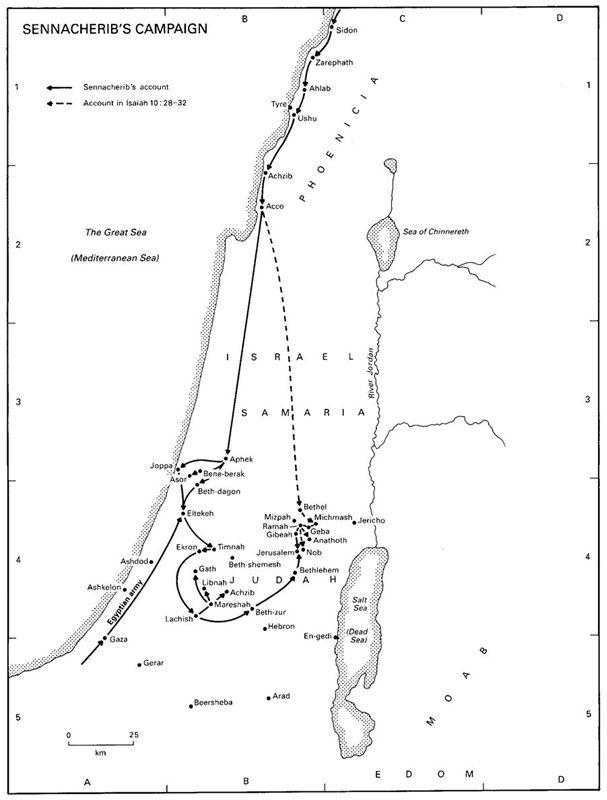


Theme: The God who will destroy all evil, death, and wicked people can be depended on to deliver those who trust him.
Setting the stage
Review
- The book of Isaiah might be compared to a pond where a stone creates a series of ever widening circles.
- The first circle: Isaiah 1-12 with a focus on Jerusalem
- The second circle: Isa 13-23 with a focus on the nations
- The third circle: Isa 24-27 with a focus on the world
- This same pattern might be more easily remembered in this way
- Isaiah 1-12—Focus on JerUSalem
- Isaiah 13-23—Focus on the UN (an ancient “United Nations”)
- Isaiah 24-27—focuse on the UNiverse.
Isaiah 13-27 moves in some new directions.
- Isa 13-23 takes up 12 nations in the ancient world
- Geographically the view expands from Israel to all the known world
- Temporally the focus moves from the late 8th century to distant events
- Isa 24-27 takes up cosmic issues
- Geographically the view moves from the world to the universe
- Temporally the focus moves from antiquity to the end of time.
Historical settings
- Isa 1-12 takes place during Syro-Ephraimite War indicated by the narrative of 7-8.
- Isa 13-23 is a bridge between Isaiah 1-12 and 24-39 and represents a wide range of historical settings.
- Isa 24-39 takes place during the Assyrian siege of 701 indicated by the narrative of 36-39
- 24-27—Isaiah uses the end time battle to give hope during the 701 siege
- 28-33—Isaiah uses the fall of North Israel to warn about the 701 siege
- 34-35—Isaiah uses the destruction as the end of the world (symbolized by Edom) and the homecoming of the faithful as a climax to his sermons during the siege.
- Assyrian invasion in 701.
- Sennacherib (704-701), the Assyrian ruler, invaded Judah in 701 B.C.
- He attacked and subdued 46 cities in the Judean countryside (according to the Sennacherib prism on which the king recorded his exploits).
- As the Assyrian army grew closer to Jerusalem, the capital of Judah, Sennacherib sent emissaries calling for the surrender of Jerusalem (Isa 36-37).
- During this time Isaiah called for trust in God. Although there are other ways to understand Isa 24-35, these lessons see these sermons as ones preached during Sennacherib’s assault on Judea and finally during the siege of Jerusalem.
Learning Experiences
Introduction
The old spiritual “He’s Got the Whole World in His Hands” (many will remember the 1958 version by English singer Laurie London) offers hope to those in the midst of trials. Isaiah 24-27 plays that same function
- Against the background of the powerful Assyrian army chewing up the Judean countryside and finally laying siege to Jerusalem, Isaiah uses a set of powerful images to provide hope and urge the people to trust God.
- He begins by describing the events that take place at the end of the world.
- Chapter 24 describes the great end time battle (much like Ezek 38 or Rev 16 and 20) in which God removes all the unjust and wicked people.
- Chapter 25 describes heavenly worship and the great end time banquet.
- Isaiah’s point seems to be that the God who will do these great things in the future will be able to deliver those who trust him in the present.
- Chapter 26 gives direction to those under Assyrian attack.
- Chapter 27 affirms that God will care for his people and eventually call all people home.
- Although other historical backgrounds are often proposed for this material, in general Isa 24-27 speaks of the larger pattern of God’s work in human history which offers hope to every specific situation.
Isa 24—The earth’s destruction at the end of time
- Outline of this chapter
- 24:1-3—God destroys all
- 24:4-13—Reason for the destruction
- 24:14-20—Response to the destruction
- 24:21-23—God destroys all
- Read 24:1-13
- 24:1-2 is parallel to 24:21-23 in that both have God taking responsibility and a description of the coming destruction.
- This section contains several list-like features
- Verse 2 lists 12 categories of people as if to say that the devastation includes all people, there are no exceptions.
- Verses 1-13 contain 42 descriptions of destruction. Which seem most devastating? Compare this with other massive destructions in Isa 13:1-9 & chapter 34. See Gn4:10-12; Num35:33-39; 2Sam2:21
- Verses 5-6 list 5 reasons for the destruction
- 5—People have polluted/defiled the earth
- 5— People transgressed laws
- 5— People violated statutes
- 5— People broke the everlasting covenant
- What covenant is considered here?
- Are all people subject to the Mosaic covenant or is this offense a violation of the Noah and Abraham covenants which were made with non Israelites?
- Many consider this list to refer to a violation of fundamental principles of human behavior (much the same way that Paul uses law in Romans).
- The key is not when, but the certainty & universal nature of God’s power
- Read 24:14-20 which is the response
- Identify the “they.” Many consider the “they” to be Israel or the heavenly court. Some simply think it is the reaction of the audience to Isaiah’s preaching.
- The “I” must be Isaiah who thinks celebration of his audience is premature or that they ignore the immense suffering
- Vv 17-20 is either a description of the coming destruction of God described in 1-13 or the out of control world in which Isaiah lives (the Assyrian invasion). This section is often called a lament in which the people express their helplessness.
Read 24:21-23—God destroys all
- The chapter closes with the same theme as 24:1-3
- Identify the powerful evil ones of the world who will be rendered impotent
- Hosts of heaven—This phrase may refer to the planets but most likely points to enemy angelic beings—2Kngs22:19; Job1:6; Dan4:32; 8:10; 10:13
- Kings of earth—see Isa 13-23
- God alone will rule
- According to v22 the punishment of evil rulers does not come immediately but they will be imprisoned and then judged.
- In v23 the white one (moon) and the hot one (sun) may reflect same idea as 60:1 that when God arrives these minor sources of light will not be needed.
- See God as associated with light—Ex3:1-6; 19:16, 18; Dt 5:24-26; Ezk 1
- God reigning over all is a theme in Isa: 6:1, 6; 32:1; 33:17, 22; 41:21; 43:15; 44:6; 52:7
- The NT mentions some of these same events: 2P2:4; Rev 6:12-15; 9:1-2; 20:1-6
Chapter 25—View into end time events
- Contrast Isaiah 24 and 25. Chapter 24 is a judgment scene while chapter 25 depicts end time worship
- The chapter is not in chronological order, but offers views of various end time events. To the people facing the mighty Assyrian army in 7012 BC, Isaiah describes a future beyond the control of any earthly force as a means of building hope and establishing trust. The chapter can be outlined in this way:
- 25:1-5—song of thanksgiving
- 25:6-8—banquet
- 25:9-12—declaration of trust
- Read 25:1-5—song of thanksgiving
- Compare this thanksgiving song with Ps 31:14; 40:5; 86:2; 118:28; 140:6
- Identify the “I.” Some believe it is the heaven bound faithful or perhaps the poor and needy of v4
- Note the reasons for giving thanks
- 25:1—God’s wondrous acts of salvation. This verse may refer to 24:1-22 as God saving the righteous from the wicked at the end time destruction.
- 25:1—God followed the plan he had from long ago.
- 25:2—God defeated a city
- 25:4—God has protected the poor
- Identify the city which is mentioned in 24:10; 25:2; 26:5; 27:10. It seems to be a symbol of world evil, or a metaphor for the wicked. It does not mean that all cities are evil.
- Identify the “strong peoples” who seem to be the formerly ungodly people who now see God’s righteousness
- See 2:1-5; 14:1-2; 19:18-25; 60:1-21; 66:19-21 with references to the nations coming to Jerusalem
- Isaiah has a worldwide focus with the hope that many people will turn from their self-sufficiency and price to join in giving glory to God.
- The poor who have been protected by God (see previous lessons) rejoice in how God has been and will be their protection. Note the metaphors used to describe this point.
- Read 25:6-8—Banquet
- Discuss those who participate in the banquet. See above and Isaiah’s concern for every tribe and nation—2:2-3; 14:1-2; 19:18-25; 45:20-25; 49:22; 56:6ff; 60:1-22; 66:18-21
- Mountains are mentioned repeatedly in Isaiah (2:2f, 14; 5:25; 11:9; 13:4; 14:25; 17:13; 18:3, 6; 22:5; 25:6f, 10; 27:13; 30:17, 25, 29; 34:3; 37:24; 40:4, 9, 12; 41:15; 42:11, 15; 44:23; 45:2; 49:11, 13; 52:7; 54:10; 55:12; 56:7; 57:7, 13; 64:1, 3; 65:7, 9, 11, 25; 66:20 [44 times]) as is Zion, the mount on which Jerusalem is centered (Zion in Isaiah: 1:8, 27; 2:3; 3:16f; 4:3ff; 8:18; 10:12, 24, 32; 12:6; 14:32; 16:1; 18:7; 24:23; 28:16; 29:8; 30:19; 31:4, 9; 33:5, 14, 20; 34:8; 35:10; 37:22, 32; 40:9; 41:27; 46:13; 49:14; 51:3, 11, 16; 52:1f, 7f; 59:20; 60:14; 61:3; 62:11; 64:10; 66:8 (46 times]) which becomes a metaphor for heaven.
- Note and discuss the banquet activities
- God will provide food for all people
- God will swallow up/destroy death
- God will wipe away all tears
- God will remove disgrace
- The banquet takes place after the end of the world’s evil in Isa 24. Since all God’s enemies are gone the reason for death is gone. All punishment for sin has taken place. Joy comes because long wait is over.
- This banquet inspires other Biblical banquets. Compare this banquet to these: Lk14:15-24; 22:14-20; Mt8:11; Rev19:6-9. See Isa 5:14, 17 and Dt14:26 where festivals demand best drink and meat
- Read 25:9-12—declaration of trust
- Note the parallels to the thanksgiving song of 26:1-5
- These verses can be outlined in two points
- 9—Declaration of trust
- 10-12—reason for trust
- Identify the “we” in v9. It is generally thought they are the banquet participants who are gathered on the mountain (6, 10) or the poor of v4 or those who praised from v1
- Moab is one of the few specific names mentioned in all of 24-27 and is generally thought to be a metaphor of those excluded from the presence of God because of sin.
- This usage may be based on the Israelite hatred of Moab reflected in Dt 23:1-8 and Isa 16:6.
- However, other texts include them. See Ruth and Isa 56.
- The treatment of Moab as being put in the sewer is a metaphor of the helplessness of the wicked.
- Vv11-12 are the people at the banquet celebrating God’s victory over those who defiled the world (24)
- Salvation of faithful in 10
- Destruction of defilers in 11-12
Chapter 26—Direction to those under Assyrian attack
- The chapter has several indications that it was preached during the Assyrian siege of 701 BC
- The reference to Judah in 26:1
- The people are told to open gates and let in the righteous ones (refugees from the countryside) (v2)
- Those inside are told to trust in God (v 4).
- 25:9 is refers to what will happen in end time while 26:1-6 describes what happens if the people trust him now.
- The illustration of the nation in pain like child birth in 26:16-18 is the same as the illustration used during the siege in Isa 37:3.
- The call to hide and wait for a little while on God in 20-21
- Isaiah uses the end time events to describe a God powerful enough and interested enough to care for the people who trust him in times of crisis.
- Outline
- 1-6—Judah’s song of trust
- 7-18—Judah’s lament
- 26:19-27:1—Salvation for Judah
- Read 1-6—Judah’s song of trust
- While Isa 24-25 spoke repeatedly of all nations Isa 26-27 are about Judah and not all of Judah but the righteous nation, the people who ”keep faith”
- While “city” in Isa 24 was a metaphor for evil, it is now a metaphor for God’s protection.
- The passage lists two qualities of people who in difficult times receive peace
- Stayed on God (in 36:6 the people tend to rely on Egypt)
- Trusts in God
- “Perfect peace” is shalom shalom
- In 5-6 God offers repeated assurance to those who are stayed on him and trusts God. Low is repeated 3xs to emphasize the point because when God destroys a city the city is so powerless that the poor can walk over them
- Read 7-18—Judah’s lament (while Sennacherib has Jerusalem under siege)
- Verses 7-10 affirm confidence in God by reminding God that he rewards those who do good and punishes those who do bad (often call retribution theology and stated clearly in Ps1; 27:11)
- Yet with the Assyrian army outside the walls (9b-10) and their lives threatened, it appears that their good lives will not be rewarded. Isaiah reminds God of the way things should be, because they are not that way and yet confesses belief in the way that they should be
- Read 11-15—petition requesting God’s action
- In vv 11-12 Isaiah calls God to punish their enemies with 4 requests
- 11—let them see God’s zeal for his people
- 11—let them be ashamed (i.e. defeated)
- 11—let them be burned with fire
- 12—ordain peace for them
- In vv 12b-15 Isaiah give three reasons why God should act
- 12b—they are dependent on God
- 13—they have had other rulers, but they acknowledge only God. The other rulers are ghosts destroyed by God
- 15—God is the one who increased Judah so surely he will not abandon his people now.
- Verse 16 is a difficult verse with 2 possible interpretations
- The faithful in Judah (they, change to we) seek God during a time of distress from which they cannot free themselves
- The unfaithful in Judah (they) seek God in manipulative ways (prayer is actually “whisper, mutter, or exorcism”)
- In verses 17-18 the situation in Jerusalem compared to pain of childbirth
- Other uses of image:
- Hopeless suffering on day of Lord—13:8
- Military destruction of Babylon—21:3
- Pain of Sennacherib’s invasion—37:3
- Labor pains in future—66:6-9
- Instead of giving birth to a child, they birth the wind (woman didn’t have a baby, but had gas) which means all the pain was for nothing
- The section ends wondering if God hears and what he will do?
Read God’s promises in 26:19-27:1
- God promises four things
- 19—God will resurrect the dead
- 20—God urges the people to wait hopefully for the end
- 21—God indicates the destruction of the wicked promised in Isa 24 will take place
- 1—God will defeat of evil
- Resurrection
- Identify the double metaphor for resurrection: being raised from the dead is
- like waking up from sleep &
- plants getting dew to survive each morning.
- Compare this resurrection with others in the OT: Dan 12:1; 1Kngs17:17-24; 2Kngs4:18-37; 13:20-21
- The identity of the resurrected is often debated. Some hold it is the nation that will be resurrected after the Assyrian attack while others (Beyer, Smith) hold it is individual resurrection. In light of the Isa 24-25’s focus on the end times the latter seems most likely.
- Israel is like a woman who cannot give birth to life (18) while God can give life to the dead (19)
- In the midst of the siege of 701, Isaiah tells the people God was not going to destroy the Assyrian threat completely, so the people would have to wait (v 20), but if they hid in the city, they would be spared, which is what happened in Isa 37
- Vv 21 describes a theophany in which God comes to punish the earth for its violence reflecting the final judgment as in Isa24 and perhaps the plague on Assyrian soldiers in 701
- 27:1 takes up Leviathan which is also mentioned in Job 3:8; 41:1-32; Ps74:14; 104:26
- Leviathan is a metaphor for the Assyrian army or all evil
- Which seems most likely?
Chapter 27 affirms that God will care for his people and eventually call all people home
- Isa 27 is unified by agricultural imagery with verses 2-6 taking up the vineyard, vv 7-11 focused on the fruit stripped from tree, barren branches burned and vv12-13 using the harvest imagery
- Outline
- 27:2-6—vineyard is a song of hope
- 27:7-11—God’s judgment explained
- 27:12-13—God returns to his holy mountain
- Read 27:2-6—vineyard is a song of hope
- Compare and contrast this allegory of the vineyard with the parable of the vineyard in Isaiah 5.
- God makes something productive and hopeful (27) out of something worthless (5) and thus offers a substantial word of hope to those facing Assyrian domination.
- In v 4 God seems to be wishing for enemies, but is probably saying if there were enemies he would defeat them for Israel
- Isaiah returns to how Israel will positively influence the whole world in vs 6.
- Discuss how these words would have offered hope during a siege.
- Read 27:7-11—God’s judgment explained
- During the siege the question would arise about if God is going to protect us, why does he not do it now. Isaiah explains that God does not punish his people as severely as he does others and that there is the unresolved issue of Jerusalem’s idolatry.
- Isaiah supports the removal of idols initiated by Hezekiah’s reforms—2Kngs18:4; 23:14-15; 2Chr31:1; 34:3-6. During the siege the Assyrian commander uses these reforms as a lever to say that the gods are unhappy with Hezekiah for removing the idols. Isaiah argues here that Hezekiah did not go far enough and the Assyrian siege is evidence.
- Note that even under such duress forgiveness is offered.
- Read 27:12-13—God returns to his holy mountain
- This worship scenes in Jerusalem parallels 2:2-4; 11:10; 14:1b-2; 19:19-25
- The faithful gather in two phases
- From within Israel
- From outside Israel. These people are called “lost” and it is not clear if it is Israel or the nations being called
- Trumpet
- The trumpet is used in OT to announce the beginning of some event
- Call to battle—Jdgs6:34
- Call to worship in temple—Lv25:9; Joel2:1,15
- Announce new king—1Kngs1:39; 2Kngs9:13
- Announce final battle—Zech9:14
- Isaiah uses the trumpet to announce that Israel always has the opportunity to start again and God will call them home just like he said in Isa 25.
Continuities
- Many Christian hymns speak of the end of the earth. Compile a list. Which ones have lines that originate in this section of Isaiah? Are these songs as popular as they once were? Why or why not?
- Do people today speak about end times with frequency? Why or why not?
- Isa 24 is a violent chapter. Review the information about violence so far revealed in Isaiah. Keep in mind that the treatment of Isa 34 will bring all this discussion of violence to a conclusion. What do you think about God killing all the wicked in a great end time battle? Who in today’s world do you think might find this attractive?
- What comfort do you find in Isa 25?
- Evaluate the proposal that Isaiah uses the end time events to encourage people during Sennacherib’s siege of Jerusalem. Would you have been persuaded? What would it like to be under siege? What evidence is there that the people in the 8th century may be the first ones to hear about these end time events?
- Look over the words to the song “Peace perfect peace.” How is the message of the song different from or the same as Isa 26:3? What role does this kind of peace play in our world? What kind of role does it play in your city? Your congregation? Your life?
- Isa 27:1 uses Leviathan as a symbol of either Assyria or evil? What do you know about Leviathan? Compare these passages which talk about Leviathan and the dragon: Isa. 27:1; 51:9; Ezek. 29:3; 32:2; Rev. 12:3f, 7, 9, 13, 16f; 13:2, 4, 11; 16:13; 20:2. Is he still alive today? What is the point of this passage? Does it speak today?
Lesson Ten: Isaiah 28-33
Title: How Firm the Foundation
Objectives:
- The student will understand how Isaiah both challenged and consoled the Jerusalem community and leadership during the Assyrian attack and siege in 701 BC.
- The student see the original setting of several well-known texts used in the New Testament.
- The student will reflect on what it means to have a firm foundation in God.
Preparation:
- A Bible for each student
- There are several songs that use the words “firm foundation.” Consider how they might be used during this lesson.
- A map of Hezekiah’s Jerusalem shows the terrain and location of the siege. See, for example, http://images.google.com/imgres?imgurl=http://www.blueletterbible.org/images/maps/Otest/jerusalem_anc2.jpg&imgrefurl=http://www.blueletterbible.org/images/maps/Otest/jerusalem_anc2.html&usg=__aJLp4-QjwEJrU7GNB5rhAOqhXdU=&h=751&w=576&sz=158&hl=en&start=2&sig2=pbq8dimI5aZZ7wDXc88OJw&itbs=1&tbnid=KzNX6TK-vXzyGM:&tbnh=141&tbnw=108&prev=/images%3Fq%3Dancient%2Bmap%2Bof%2Bjerusalem%26gbv%3D2%26hl%3Den&ei=FddqS5bdJpP6Nd311OIE

Theme: During a time of crisis, the prophet Isaiah calls for the people to rest their security and future on the firm foundation of God’s plans.
Setting the stage
Review the previous review sections as preparation for summarizing the past classes.
Historical settings for the book of Isaiah
- Isa 1-12 takes place during Syro-Ephraimite War. Events during the war are summarized in Isa 7-8.
- Isa 13-23 is a bridge between Isaiah 1-12 and 24-39 and represents a wide range of historical settings.
- Isa 24-39 takes place during the Assyrian siege of 701. Some events during the siege are narrated in Isa 36-39.
- 24-27—Isaiah uses the end time battle to give hope for their present
- 28-33—Isaiah uses the fall of North Israel to warn about their present
- 34-35—Isaiah uses Edom to warn about their present
- 36-39—Isaiah narrates events at the end of the 8th century leading up to the Assyrian invasion in 701.
- Assyrian invasion in 701.
- Sennacherib (704-701), the Assyrian ruler, invaded Judah in 701 B.C.
- He attacked and subdued 46 cities in the Judean countryside (according to the Sennacherib or Taylor Prism on which the king recorded his exploits).
- As the Assyrian army grew closer to Jerusalem, the capital of Judah, Sennacherib sent emissaries calling for the surrender of Jerusalem (Isa 36-37).
- During this time Isaiah called for trust in God. Although there are other ways to understand Isa 24-35, these lessons see these sermons as ones preached during Sennacherib’s assault on Judea and finally during the siege of Jerusalem.
Learning Experiences
- Isa 28-33 represents the messages that Isaiah spoke in Jerusalem in the days leading up to and during the Assyrian siege. In these messages, Isaiah occasionally refers to the crisis of the Assyrian attack on Jerusalem including these passages.
- 28:11 may refer to the Assyrian generals and soldiers speaking different languages just outside the walls.
- 28:15, 18 compares the Assyrian conquest of the Judean countryside and the siege on Jerusalem to a epidemic.
- 29:2-3 may point to the Assyrian military equipment visible from the Jerusalem walls.
- 29:5-8 may anticipate the way in which the siege will end, quickly and in an unmilitary fashion.
- 30:1-7 implies that Judah has sent ambassadors and gifts to Egypt in a risky attempt to gain assistance.
- 30:15-16 notes the military hope of using horses to defend the city, a possibility mentioned by the Assyrians in 36:8-9.
- 30:31-33 again anticipates the way in which the siege will end, quickly and in an unmilitary fashion.
- 31:5 makes direct reference to God’s protection of Jerusalem.
- 31:8-9 again refers to the end of the siege including perhaps a veiled reference to the death of the Assyrian king, Sennacherib..
- 32:9 makes a remarkable note about the unexpected complacency among the Jerusalem wealthy.
- 33:7-9 describes the war-torn countryside.
- 33:18-19 wonders what happened to the Assyrian military strategists.
- The repeated use of the word “woe” provides unity and structure to this section.
- General observations:
- Each “woe” introduces something which threatens Jerusalem or its attackers followed by God’s promise of hope and salvation.
- The “woe” connotes a sense of sadness and grief at the current situation suggesting that Isaiah does not play the role of a distant judge handing out rebuke, but rather is a man whose heart is broken over the situation facing the city. By taking this approach, Isaiah expresses solidarity with the people to whom he now shares both bad news and good news.
The six units are thus summarized:
- 28:1-29—Build on the firm foundation of the Lord of hosts not the drunken leaders of Jerusalem.
- 28:1 pronounces a woe on Jerusalem’s leaders who are in the process of making the same bad decisions made by the now deposed leaders of North Israel.
- Instead Isaiah calls the people to rest on a “sure foundation” of trusting in God.
- 29:1-14—Draw near to God for complete protection
- 29:1 pronounces a woe on Jerusalem pointing to a siege.
- Instead Isaiah reminds the people of the marvelous things God will do for people who not only honor them with their lips but who give him their hearts.
- 29:15-29—God is the potter, the people are the clay.
- 29:15 pronounces a woe against those who counsel the king to trust in secret plans.
- Instead Isaiah reminds the people of what God will do with submissive followers.
- 30:1-26—Hear the instruction of the Lord.
- 30:1 pronounces a woe on those who pursue plans that are not God’s.
- Instead Isaiah counsels the people to follow God’s plan.
- 31:1-32:20—Jerusalem receives God’s spirit.
- 31:1 pronounces a woe on those who trust Egypt to save them from Assyria.
- Instead Isaiah urges the people to trust the Holy One of Israel.
- 33:1-24—The Lord is exalted for he dwells on high.
- 33:1 pronounces a woe on Assyria.
- Isaiah reminds the people that God will fight for them.
28:1-29—Build on the firm foundation of the Lord of hosts not the drunken leaders of Jerusalem.
- 28:1 pronounces a woe on Jerusalem’s leaders who are in the process of making the same bad decisions made by the now deposed leaders of North Israel.
- Isa 28:1-6 reflects on the fall of North Israel in 721 which occurred about 20 years before the crisis of the Assyrian invasion of Jerusalem (701). Using a double metaphor, their leaders are compared to drunks and to fading flowers.
- In Isa 9:8-21 in the aftermath of the Syro-Ephraimite War (734-32) Isaiah predicted the fall of North Israel (721) and now (in 701) explains the fall of North Israel as the result of poor leadership.
- Instead Isaiah calls the people to rest on a “sure foundation” of trusting in God.
- Isa 28:7-29 applies the bad example of North Israel to the leaders (see prophets and priests in v 7) of Jerusalem (see the scoffers who rule in Jerusalem in v 14).
The chapter contains three units
- 28:7-13 is built around a nursery rhyme which appears twice (10, 13). There are a variety of ways to interpret this material. One way that reads the whole chapter in a consistent way is to understand Isaiah accusing Jerusalem’s leaders of being drunk (7-8) due to their poor leadership (8) to which they protest that they understand God’s will (9) which to them is as simple as a nursery rhyme (10). Since the people inside Jerusalem can hear the Assyrians speaking another language in the siege camp outside the wall (11), Isaiah predicts that they will be taken into exile (12) where God’s word will be preached in a language they do not understand, making as much sense of reality as a nursery rhyme (13).
- 28:14-22 is built around two ways of preparing for the “overwhelming scourge” (vv 15, 18) which is the Assyrian siege.
- The drunk prophets and priests scoff at Isaiah (vv 14, 22) because they have a “covenant with death” (15, 18), which was based on their theology that since God’s temple was in Jerusalem and since God lived in his temple, Jerusalem would never fall.
- Isaiah responds with a second way of dealing with the siege. He calls the people to build not on the presence of the temple, but on the sure foundation of belief in God. His plans for the Davidic house (see Isa 9:1-7; 11-9) were a more certain foundation.
- 28:23-29 uses a farming illustration (much like Isa 5 and 27) in which just as the farmer knows how to plant, harvest and process crops, so God knows how to lead Jerusalem. The implication is that just as harvest often involves some violent acts (beating dill with a stick, v 27), so God’s plans for Jerusalem involve violent acts to discipline his people (siege of 701).
- Read 28:9-13.
- Based on this study of Isaiah, what are the precious cornerstone and the sure foundation? The word for “sure” and “believes” is the same word (the same root as our word “amen”) used in the discussion with Ahaz in Isa 7:9 from which we get the word faith.
- These lines (along with Isa 8:14) are quoted repeatedly in the NT. Note the new setting in which the words occur in Mt 21:42; Acts 4:11; Rom 9:33, 10:11; Eph 2:20; 1Tim 1:16; 1Pet2:4-6.
29:1-14—Draw near to God for complete protection.
- 29:1 pronounces a woe on Jerusalem and announces the siege.
- Ariel is another name for Jerusalem where the temple was located and where the yearly feast days (29:1) were celebrated.
- God announced he would send a siege (3) forcing the people into a distressing situation compared to be buried alive in the earth (4)
- Instead Isaiah reminds the people of the marvelous things God will do for people who not only honor them with their lips but who give him their hearts.
- Isa 29:1-14 revolves around three issues:
- Isaiah describes the status quo theology of the city as one based on “we are safe because this is God’s city where the feast days are held” (29:1) which Isaiah compares to being drunk (9-10) and to not being able to read (11-12)
- Isaiah isolates the problem as the superficial nature of their faith (13)
- Isaiah promises that God will do wonderful and marvelous things (14) for those who dedicate their hearts to him (13) and briefly describes what marvels God will do to their enemies (5-8).
- Read 29:13-14.
- Isaiah accuses the people of Jerusalem and its leaders as having a shallow, legalistic faith. How does this accusation fit with his preaching about community in Isa 1, 2, 3 and 5? Reread the critique of their worship in Isa 1:10-17. The people (in Isa 1:10-17) honored God with their lips, but in Isa 1 the people are critiqued for a faulty vertical relationship with God in 1:2-4 and faulty horizontal relationships in the community in 1:16-17.
- The Old Testament often refers to God doing wonderful and marvelous things. Use a concordance and make a list of some of those wonders.
- Jesus cites this passage in Mt 15:8-9 and Mk 7:6-7. Discuss how Jesus uses Isaiah’s words.
- 29:15-29—God is the potter, the people are the clay
- 29:15 pronounces a woe against those who counsel the king to trust in secret plans.
- According to Isa 36:1-3, 11; 37:1-4, King Hezekiah had many advisors during the Assyrian siege. According to the Assyrian commander Hezekiah had asked Egypt for help (37:6). It appears that during the siege some advised Hezekiah to rely on Egypt while Isaiah called for reliance on God.
- This woe critiques those advisors who called Hezekiah to form foreign alliances as a way out of the siege.
- Isaiah compares the situation to a piece of pottery that tells the potter what to do (see the ax and saw that tell the carpenter what to do in Isa 10:15).
- Instead Isaiah reminds the people of what God will do with submissive followers. The devastation of war (17-21) will be reversed and those who give bad advice and face shame will be changed (22-24).
- Read 29:16.
- Compare this passage with Isa 45:9; 64:8 and Jer 18:1-6.
- In this comparison who in Jerusalem plays the role of the clay and who is the potter?
- Note the way in which Paul makes use of this illustration in Rom 9:19-21.
30:1-26—Hear the instruction of the Lord.
- 30:1 pronounces a woe on those who pursue plans that are not God’s.
- Isaiah knows Hezekiah has sent ambassadors to Egypt seeking to rely on military help rather than God’s protection. He critiques that action (1-7).
- He mockingly imagines the risky trip of the ambassador’s party loaded with gifts for Egypt as they travel through the wilderness areas between Jerusalem and the Egyptian court (6).
- Instead Isaiah counsels the people to trust in God (30:8-33).
This section has three units:
- 30:8-14 takes up God’s reliability in contrast to the illusions of the false counselors.
- Isaiah seeks to have his words written down (v 8), much like he did in 8:16, so future generations will see that God does what he said he will do.
- Isaiah critiques the false prophets who give bad advice and compares Jerusalem leadership to a wall about to collapse (13), a frightening image for a city under siege.
- 30:15-17 explains Isaiah’s counsel and the results of it being ignored.
- He calls for them to do four things (15):
- Return to God
- Rest in his salvation
- Be quiet in expectation
- Trust in God
- Isaiah indicates that military solutions will end in defeat (16-17).
- 30:18-33 explains God’s promises to the people.
- God will be gracious to those who exalt him (18), calls them to listen to those who teach the law (20) and calls them to destroy the idols (22).
- 30:23-26 outlines the results of God’s grace.
- 30:27-28 explains that God will come to deal with the nations.
- 30:29-33 anticipates the rejoicing of God’s people when he triumphs over their enemies.
- This section of Isaiah lists many qualities of God. Make a list and discuss. Keep in mind that Isaiah is fundamentally a book about God.
- Read verses 13 and 18.
- Isaiah puts the point of his book in succinct form.
- How do these verses clarify the message of the book of Isaiah?
- How do these verses describe the God-human relationship?
- How enduring is that description?
31:1-32:20—Jerusalem receives God’s spirit.
- 31:1 pronounces a woe on those who trust Egypt to save them from Assyria.
- The “helpers” (31:1, 2, 3) refer to Egypt and those who “go down” to Egypt are Hezekiah’s counselors.
- Isaiah again critiques the reliance on Egypt. See Isa 30:1-7.
- Instead Isaiah urges the people to look to the Holy One of Israel.
This section includes four units.
- 31:4-9 points to God’s deliverance of those who repent.
- God can be as powerful as a lion (4) and as attentive as a bird (5) to those who repent (6).
- Those who cast aside their idols (7) will be delivered from the Assyrians (8-9) and then God will defeat the Assyrians (8-9)
- 32:1-8 describes God’s coming king.
- Compare with Isa 9:1-6 and 11:1-6.
- Isaiah offers a civics course. Isaiah is in the midst of the indecision during the invasion of 701. Hezekiah has advisors that prompt him to send ambassadors to Egypt for help while Isaiah that calls him to trust God. Isaiah rehearses how God intends for the government to function. The king who does righteousness and justice will be protected by God and the people will live in integrity and even the unwise will be drawn into the well being of the community. Such a ruler will install the correct leaders and those with other less helpful skills and low motives will not be in seats of authority. Even in the midst of a siege God continues his concern for the lowest members of the community.
- 32:9-14 outlines the future.
- Before God’s kingdom comes, there will be judgment and mourning.
- Those who even in the midst of siege (the complacent daughters) live in comfort will not escape God’s judgment.
- 32:15-20 tells of God’s spirit at work.
- The spirit who made the first creation (Gen 1:2) will remake Jerusalem.
- God continues to imagine a community of peace (see 11:1-9).
- Read 32:15-20
- This section is filled with theological words. Explore each one. Cite the earlier definitions of justice and righteousness. Explore the continual appearance of quietness, trust and peace.
- Note the images of this section: The coming of the spirit is compared to water being poured, the new community is compared to a forest and field, and the people’s well being is likened to animals in their natural state. How are these images helpful?
33:1-24—The Lord is exalted for he dwells on high.
- 33:1 pronounces a woe on Assyria.
- After five woes on his own people, Isaiah now turns to the enemy outside the walls.
- The nature of Assyrian treachery is unclear but may be related to the speeches of the Assyrian commander on the walls and the letter sent to Isaiah (see Isa 36-37) or the broken treaties (33:8).
- The point of 33:1-9 is that those who destroy will be destroyed but God will be gracious those who wait and exalt him.
- Isaiah reminds the people that God will fight for them.
The future is divided into four sections.
- 33:10-12 describes the fate of the unfaithful idolaters in Jerusalem.
- 33:13-16 addresses the fear of the survivors who in light of God’s massive destruction seek to know what they must do to approach God. Isaiah summarizes it succinctly in language that reflects other such descriptions (compare with Psa 15, 24).
- 33:17-19 assures the survivors that they will see God’s king but will not see the insolent who opposed God.
- 33:20-24 offers majestic metaphors to describe the new Jerusalem. There will be victory festivals, Jerusalem will be like a river in a dry land. Then dropping the metaphors, Jerusalem is described as a place of abundance, health and forgiveness.
- This chapter contains many descriptions of God.
- Make a list and compare them to previous lists.
- Exalting God over the pride and self-sufficiency of the world is a major agenda in Isaiah especially in this chapter: 5, 10, 21-22
Read 33:5-6.
- Compare this verse with Isa 29:14; 30:15, 18. What parallels exist? What differences?
- Compare the teaching of these two verses with Mt 6:33.
Read 33:13-16.
- This material is often called an “entrance liturgy,” that is the kind of qualities God expects of those who enter his presence.
- Compare with other such lists in Psa 15 and 24.
Continuities
- Think of several recent crises (9-11, Katrina, a local tragedy, a congregational event). How do the messages of Isaiah during the crisis of 701 inform contemporary situations? Make a list of things that Isaiah would say not to do during a crisis and things to do during a crisis. List some passages from Isaiah that might be helpful readings during a church service that comes immediately after a crisis.
- How does Isaiah describe God? Compare Isaiah’s description of God with descriptions of God in the New Testament. How might Isaiah’s descriptions of God be incorporated into worship?
- Discuss Isaiah’s use of the word “woe.” Recall speakers who are judgmental from a distance as oppose to those who critique while sharing the pain. What responses do people have to each kind of speaker?
- Imagine being among the crowds of Jerusalem who turned out to hear Isaiah speak. What are the reactions to Isaiah’s words? What advice might Isaiah give to those who have to speak during a crisis?
Lesson Eleven: Isaiah 34-35
Title: When the Clouds are Rolled Back as a Scroll
Objectives:
- The student will see how Isa 34-35 provides a suitable conclusion for Isa 28-33
- The student will be able to understand the role of violence in the Bible
- The student will reflect on heaven and hell as the parameters of the human future.
Preparation:
- A Bible for each student
- Teachers may find it helpful to read material on violence in the Bible. Consider:
- Terence Fretheim, “God and Violence in the OT” Word and World 24 (Winter 2004) 18-28.
- Harold Shank, “Violence: God and the Sword (1 Sam 15),” pages 277-296 in Listening to His Heartbeat—What the Bible Says About the Heart of God. Joplin: College Press, 2009.
- Teachers may find it helpful to listen to one of these lessons:
- Harold Shank, Is Heaven a Fairy Tale?
- Harold Shank, Would a Good God Sent People to Hell?
- Find the words to the song It is Well with my Soul which contains the line about the heavens being rolled back as a scroll. See http://library.timelesstruths.org/music/It_Is_Well_with_My_Soul/
Theme: The day is coming when the clouds will be rolled back as a scroll. For some it will be a day of destruction and others a day of delight.
Setting the stage
Review the previous review sections as preparation for summarizing the past classes.
Historical settings for the book of Isaiah
- Isa 1-12 takes place during Syro-Ephraimite War. Events during the war are summarized in Isa 7-8.
- Isa 13-23 is a bridge between Isaiah 1-12 and 24-39 and represents a wide range of historical settings.
- Isa 24-39 takes place during the Assyrian siege of 701. Some events during the siege are narrated in Isa 36-39.
- 24-27—Isaiah uses the end time battle to give hope for their present
- 28-33—Isaiah uses the fall of North Israel to warn about their present
- 34-35—Isaiah uses Edom to warn about their present
- 36-39—Isaiah narrates events at the end of the 8th century leading up to the Assyrian invasion in 701.
Assyrian invasion in 701.
- Sennacherib (704-701), the Assyrian ruler, invaded Judah in 701 B.C.
- He attacked and subdued 46 cities in the Judean countryside (according to the Sennacherib or Taylor Prism on which the king recorded his exploits).
- As the Assyrian army grew closer to Jerusalem, the capital of Judah, Sennacherib sent emissaries calling for the surrender of Jerusalem (Isa 36-37).
- During this time Isaiah called for trust in God. Although there are other ways to understand Isa 24-35, these lessons see these sermons as ones preached during Sennacherib’s assault on Judea and finally during the siege of Jerusalem.
- There is considerable discussion about the role of Isa 34-35 within the book of Isaiah.
- Study the two chapters and note the links between the two. These links suggest that they go together.
- Isa 34 is also remarkably similar to Isa 13. Some think there is some connection between the two chapters but that they are now out of place in the book of Isaiah. Others find links between Isa 35 and 40 and draw the same conclusions. These parallels must be noted, but it is easier to keep the chapters in context.
- This study views Isa 34-35 as the climax to the woe oracles Isaiah delivered in Jerusalem during the siege negotiations narrated in Isa 36-37 and that Isaiah by viewing far into the future was offering comfort to those whose tomorrow looked uncertain.
- Isa 34-35 takes the listener into the distant future just as Isa 24-27 did. Knowing the end helps navigate in the present.
Learning Experiences
Read Isa 35:3-4
- The passage is addressed to those in some kind of crisis. Explore how this description might fit people inside Jerusalem during the Assyrian siege of 701.
- Verse 4 describes two different expectations of God’s future work. Discuss how those expectations might have been received by the fearful people described in v 3.
- God will come with vengeance to provide recompense against those who have treated others unjustly.
- God will come to save those who have been faithful
- These two expectations provide an outline for Isa 34-35. They describe two different expectations of what God will do in the future.
- Isa 34—The clouds will be rolled back as a scroll. This chapter describes how God will come to take vengeance on all those who have opposed him. Edom is used as a key example of what God will do. The chapter takes up how God will make all the wrongs right.
- Isa 35—They shall see the glory of the Lord. This chapter provides a glimpse into the transformation God will bring to the world of those he redeems and ransoms. The chapter explores the results of God’s dealing with the world’s injustices (ch 34) that results in a joyful new world where all is transformed.
Isa 34
Use the following outline to show how this chapter unfolds
- 34:1-2—In the opening verses God calls the entire world to listen to his announcement that he is angry with them and has doomed them to slaughter.
- 34:3-7—The chapter then turns to a series of picturesque and often offensive metaphors to describe the total destruction of the known world and universe.
- At creation God rolled out sky like cloth (see Isa 40:22), in future he will roll it up like scroll. At creation God turned on lights, in the future he will turn off the lights.
- Brueggemann in his commentary (Walter Brueggemann, Isaiah 1-39, Louisville: Westminster John Knox, 1998, p. 270) notes that Isaiah compares the coming destruction to the sacrificing of animals just as the genocide of WWII is often described as a sacrifice with the term “Holocaust” which means burnt offering.
- 34:8-15—Isaiah considered Edom the classic explanation of how God will settle matters in the end time.
- According to Amos 1:11-12 Edom had committed well-known and unaddressed atrocities against Judah and Israel. Although the details of this matter are lost, it was apparently on the minds of those inside Jerusalem facing the Assyrian siege. After all if God had not addressed the Edomite atrocities, how could anyone expect him to address the Assyrian siege?
- The words “vengeance” and “recompense” in v8 anticipate the summary statement in 35:3-4
- Isa 34 describes God settling an unresolved matter of injustice, wickedness or oppression.
- The focus of this section is on the complete and utter desolation of the Edomites, and through their example, the ultimate removal of all nations and peoples who opposed God and who committed wicked and unaccounted for acts in human history. There will be no survivors.
- 34:16-17—In the final verses Isaiah urges the people to read what has previously been written. During the siege the people apparently had access to previous judgments and predictions which history had now proved to be true. Reread Isa 8 and 30 to see references to Isaiah’s words being preserved. The final verse reverses the work of the book of Joshua in which lots were taken to divide up the land among the people, whereas in the future God will cast lots to divide up the land among the remaining scavenger animals.
- Isaiah 34 is particularly violent.
- Isaiah seems to have used this chapter and the next as a conclusion to his series of “woes” (chapters 28-33) during the Assyrian invasion. His appeal to the future acts of God aims to affirm God’s ultimate presence with those faithful people suffering during the siege and punishment on the wicked whose deeds precipitate the invasion.
- This chapter also provides a time for a broader discussion of the violence of God as it has unfolded in Isaiah and as it is portrayed in the Bible.
God and violence
- Review of violence in Isaiah
- The terror passages of Isaiah 2:10, 19, and 21 suggest Jerusalem was a place of extreme human violence: 1:15; 18 (scarlet and crimson refer to shed human blood), 21; 2:7b; 3:14-15. To those who were oppressed, the coming terror on the uncaring ruling class in Jerusalem was a word of hope and may be the context in which we are to read 2:2-4 and 4:2-6. God announces the coming destruction well in advance and pleads for a change of heart: 1:18-20; 2:5, 22.
- The vineyard parable in Isa 5 adds another crucial element to understanding how God acts. When he resorts to violence it is only after years and decades of pursuing alternative courses.
- The images in 5:26-30 of the invading army provides additional information on the nature of God’s destruction and violence.
- Summary of Isaiah 1-6. God holds his own people accountable, he gives specific examples of what prompts such violence, he asserts that the people’s denial of the problems will not deter the punishment, he sent prophets to teach and warn, and he announces that it is appropriate to fear the destructive power of God.
- In Isa 7-10 God promises to take violent actions against North Israel and Assyria.
- The homecoming of God’s people in Isa 11 calls for giving up violence (see 2:1-4; 11:6-9, 13) and the use of violence (14) which seems contradictory. These verses may anticipate the bitterness between the later Jews and Samaritans seen in Ezra and Nehemiah and in the NT (cf. Jn 4). There also seems to be evidence of conflict in post exilic Jerusalem discussed in Isa 56-66. One explanation is that enacting the kind of righteous and equitable community of Isa 11:1-9 may call for firm measures against those who oppose a righteous and equitable community because they hoard resources and refuse to participate in community well-being. Consider that the wicked of any age challenge the kind of community that God imagines. God often uses violence to remove their resistance.
- Isaiah 13-23 explores the nature of God’s power. God used violence as a means of dealing with wicked nations (14:4-6; 13-15). These chapters also give voice to the victims of injustice violence that are otherwise unheard.
- Isa 26:21 describes a theophany in which God comes to punish the earth for its violence reflecting the final judgment as in Isa 24 and perhaps the plague on Assyrian soldiers in 701.
- Isa 28:23-29 uses a farming illustration (much like Isa 5 and 27) in which just as the farmer knows how to plant, harvest and process crops, so God knows how to lead Jerusalem. The implication is that just as harvest often involves some violent acts (beating dill with a stick, v 27), so God’s plans for Jerusalem involve violent acts to discipline his people (siege of 701).
Note these broader issues about God and violence as expressed in the Bible
Violence exists in both OT and NT
- OT
- Genesis 6:13 And God said to Noah, “I have determined to make an end of all flesh, for the earth is filled with violence because of them; now I am going to destroy them along with the earth.
- Genesis 19:24 Then the LORD rained on Sodom and Gomorrah sulfur and fire from the LORD out of heaven; 25 and he overthrew those cities, and all the Plain, and all the inhabitants of the cities, and what grew on the ground.
- Deuteronomy 20:17 You shall annihilate them– the Hittites and the Amorites, the Canaanites and the Perizzites, the Hivites and the Jebusites– just as the LORD your God has commanded
- 1 Samuel 15: 3 Now go and attack Amalek, and utterly destroy all that they have; do not spare them, but kill both man and woman, child and infant, ox and sheep, camel and donkey.'”
- NT
- Matthew 13: 41 The Son of Man will send his angels, and they will collect out of his kingdom all causes of sin and all evildoers, 42 and they will throw them into the furnace of fire, where there will be weeping and gnashing of teeth.
- Luke 19: 44 They will crush you to the ground, you and your children within you, and they will not leave within you one stone upon another; because you did not recognize the time of your visitation from God.” 45 Then he entered the temple and began to drive out those who were selling things there
- Acts 5:5 Now when Ananias heard these words, he fell down and died. And great fear seized all who heard of it
- 2 Thessalonians 1: 7 when the Lord Jesus is revealed from heaven with his mighty angels 8 in flaming fire, inflicting vengeance on those who do not know God and on those who do not obey the gospel of our Lord Jesus.
- Revelation 14: 10 they will also drink the wine of God’s wrath, poured unmixed into the cup of his anger, and they will be tormented with fire and sulfur in the presence of the holy angels and in the presence of the Lamb.
- The OT calls for peace.
- Isaiah 2: 4 He shall judge between the nations, and shall arbitrate for many peoples; they shall beat their swords into plowshares, and their spears into pruning hooks; nation shall not lift up sword against nation, neither shall they learn war any more.
- Isaiah 9: 6 For a child has been born for us, a son given to us; authority rests upon his shoulders; and he is named Wonderful Counselor, Mighty God, Everlasting Father, Prince of Peace
- Isaiah 11: 6 The wolf shall live with the lamb, the leopard shall lie down with the kid, the calf and the lion and the fatling together, and a little child shall lead them.
- 4. God sharply rejects violent people:
- “The Lord…hates the lover of violence” (Ps 11:5),
- God commands that Israel “do no wrong or violence to the alien, the orphan, and the widow” (Jer 22:3)
- God demands that violators of the command “put away violence and oppression” (Ezek 45:9),
- God condemns those who do “violence to the earth” (Hab 2:8, 17; see Zeph 1:9).
- 5. Divine violence cannot be minimized or denied
- Flood
- Sodom and Gomorrah
- Sacrifice of Isaac
- 10 plagues
- Passover night deaths
- Destruction of Jericho
- Conquest
- Amalekites
- Destruction of North Israel and Jerusalem
- Hell
- God often uses existing human entities as “agents” of his violence
- God works through agents in many ways
- Isa 10:5 (“Assyria, the rod of my anger”)
- Isa 45:1 (God’s “anointed,” Cyrus of Persia).
- God’s agents of judgment commonly exceed their mandate
- Isaiah 10: 6 Against a godless nation I send him, and against the people of my wrath I command him, to take spoil and seize plunder, and to tread them down like the mire of the streets. 7 But he does not so intend, and his mind does not so think; but it is in his mind to destroy, and to cut off nations not a few.
- Jeremiah 25:14 For many nations and great kings shall make slaves of them also; and I will repay them according to their deeds and the work of their hands.
- Jeremiah 50:29 Summon archers against Babylon, all who bend the bow. Encamp all around her; let no one escape. Repay her according to her deeds; just as she has done, do to her– for she has arrogantly defied the LORD, the Holy One of Israel.
Based on the above material several observations help explain God’s use of violence
- God’s use of communal violent often hurts innocent people
- Just as the removal of a tumor destroys healthy tissue, so God’s communal violence hurts the innocent.
- The Bible seems to reason that at times the innocent die for the larger good of the world community.
- His violence has two basic purposes: judgment and salvation.
- God often judges one nation to save another
- Ethnic cleansing of Canaanites in conquest is explained in two ways
- So Israel will not be led astray by their seductive religious practice–Deuteronomy 7:1-5
- Israel is executing God’s punishment –Deuteronomy 9:4-6
- His violence is seldom immediate and often centuries after the initial acts of wickedness.
- Gen 15:16-21 announces punishment on the peoples of Canaan for their wickedness. The year is approximately 2000 BC. Joshua in 1400 BC conquers the land and is the agent of God’s punishment.
- In Exod 17 the Amalekites attack Israel on the way out of Egypt. The year is approximately 1440 BC. In 1 Sam 15 God finally orders punishment for the Amalekites. The year is about 1100 BC.
- Divine violence is only in opposition to human violence.
- God’s use of violence must be considered in light of the Bible’s major doctrines. God is eternal and sovereign but enters into relationship with humanity. He clearly outlines the benefits of that relationship and the conditions under which it can thrive. God himself regularly comes to the earth to maintain that relationship in addition to sending prophets and teachers. All of this material is clearly explained in the book he provides for the human race.
- God does not coerce this relationship. Humans must enter a relationship with God willingly which also means that they can reject the relationship and live completely counter to the kind of ideal world that God expects.
- God through covenant, preaching, the cross, worship, the church and a host of other means provides ways of mending the divine-human ruptures. He often waits patiently while sin spirals deeper toward depravity (see Judges or Isaiah 9). God even allows humans to oppress others including the most vulnerable and faithful on the earth. Humans often express dismay with how God permits injustice to continue.
- However, as Isaiah clearly teaches, at some point (perhaps known only to God) God responds to stop the human wickedness, depravity and violence. Stopping it includes violence.
- We might imagine seeing one man with a knife in hand bent over the body of another man who is motionless. With just that information we might suspect a murder in process. However, if we learn that the scene takes place in an operating room that the motionless man has a tumor and the other man has spent years training on how to remove the tumor, our understanding of the situation changes. Many people who critique God’s violence are like those who respond without seeing the whole picture.
- Forest fires are destructive to humans and the earth. One of the most effective ways of stopping forest fires is back fires in which the firefighters start another forest fire to deprive the out of control fire of fuel thus stopping it. Using fire to fight fire mirrors God’s use of violence to fight violence.
The complete view of the future.
- In the midst of a violent time (the Assyrian invasion), Isaiah promises that God will use violence to fight violence (Isa 34) but also reveals the result of that use of violence (Isa 35). Despite the lengthy treatment of violence, Isaiah’s presentation allows this lesson to conclude on a positive note.
- When the wicked world is put in its place (Isa 34) three things happen (Isa 35)
- Nature is renewed—35:1-2
- People are renewed—35:4-7
- Future is renewed—35:8-10
- Compare the description of the future in Isa 6:9-10 with this depiction of a God planned eternity in 35:5-6
- Read 35:8-10.
- This passage describes the “Holy Way,” the road that those who are faithful to God will travel as they move into the God designed future.
- What is the significance of those who are not on the road? What happened to these people and animals?
- Redemption and ransom are often taken to refer to one’s personal experience of having the bondage of sin removed, but here the terms refer to a universal redemption and ransom. When a person is redeemed, they continue to sin only to have that sin continually removed by the ransom of the cross. The people on this road travel on a highway where sin and wickedness have been removed from reality. Review the scene of the heavenly banquet in Isa 25. Explore the differences between individual redemption and universal redemption.
Continuities
- Weigh the issues involving God and violence. What is most helpful? What remains problematic? Why is it problematic? Discuss whether the people in Jerusalem found Isaiah’s explanation helpful.
- Plan to have someone share a story of an unresolved injustice (a victim of a drunk driver where the offending party continues to drive, a family whose house was burglarized by people who were never caught, etc). How do people deal with these situations? What are some cases of unresolved injustice where the pain is much more intense? Identify some popular songs or movies that deal with these issues. Who makes these injustices right? How can Christians communicate the biblical response?
- Hell receives bad press in contemporary society. What bothers people about hell? Compare and contrast heaven and hell. Why does hell seem to have lost its motivating power? Do you believe that Isa 34-35 will happen one day?
- Compare Isaiah’s description of life of the faithful in the future with the Jesus’ description of heaven (for example John 14) or John’s presentation in Revelation. What is appealing about this kind of future? Who does it most appeal to?
Lesson Twelve: Isaiah 36-37
Title: My King Can Beat Your King
Objectives:
- The student will see how Isa 1-39 ends with a climax that involves the supremacy of God and the value of faith in him.
- The student will reflect on what it means to rely on or trust in God.
- The student will understand how God views human pride.
Preparation:
- A Bible for each student
- Review the parallel passages in 2 Kings 18-19 and 2 Chron 32
- Read the relevant passages on the Taylor Prism about the Assyrian attack on Jerusalem in 701 B.C.
- See pictures and explanation at http://en.wikipedia.org/wiki/Taylor_prism
- See a translation at http://www.utexas.edu/courses/classicalarch/readings/sennprism.html
- There are ample references to the events of Isa 36-37 that have been found by archaeologists. For a summary of these see: http://www.biblehistory.net/Hezekiah.pdf
- Read Josephus’ description of these events in Antiquities of the Jews, 10.2.5. See http://www.sacred-texts.com/jud/josephus/ant-10.htm
- Consider the poem by Lord Byron, The Destruction of Sennacherib. The poem is found at http://quotations.about.com/cs/poemlyrics/a/The_Destruction.htm
Theme: The biblical God is the supreme God.
Setting the stage
- Review the previous review sections as preparation for summarizing the past classes.
- Review Isaiah’s encounter with Ahaz in Isa 7-8 as preparation for Isa 36-39.
- Historical settings for the book of Isaiah
- Isaiah 1-12 takes place during Syro-Ephraimite War. Events during the war are summarized in Isaiah 7-8.
- Isaiah 13-23 is a bridge between Isaiah 1-12 and 24-39 and represents a wide range of historical settings.
- Isaiah 24-39 takes place during the Assyrian siege of 701.
- Isa 36-37 narrates scenes from the Assyrian invasion in 701.
- Sennacherib (704-701), the Assyrian ruler, invaded Judah in 701 B.C.
- He attacked and subdued 46 cities in the Judean countryside (according to the Sennacherib or Taylor Prism on which the king recorded his exploits).
- As the Assyrian army grew closer to Jerusalem, the capital of Judah, Sennacherib sent emissaries calling for the surrender of Jerusalem (Isaiah 36-37).
- During this time Isaiah called for trust in God.
- There is considerable discussion in the commentaries about the events described in Isa 36-39 that revolve around two issues.
- Which came first? Since Isa 36-39 is also found in 2 Kings 18-19 (almost word for word), debate rages over which one is original and which one is the copy. Gary Smith [Isaiah 1-39, The New American Commentary, Nashville: B&H, 2007, pp. 591-92] presents the arguments for each side. The final conclusion has little effect on the current study.
- What is the order? Most students of Isaiah agree that Isa 36-39 is not in chronological order. Merodach-Baladan, the Babylonian king, is mentioned in Isaiah 39 which appears after the Assyrian siege of Isaiah 36-37 which took place in 701 B.C. However, Merodach-Baladan ruled Babylon twice: 722-710 and 704-03. Additionally, Isa 38:6 spoken during the illness of Hezekiah refers to God’s deliverance of Jerusalem (found in Isa 36-37) as being a future event. Many believe that Isaiah rearranged the passage so that the Babylonian materials could come at the end preparing the reader for the Babylonian section in Isaiah 40-55. See a discussion of the issue in Smith’s commentary (pp. 584-87).
- The final conclusion has little effect on the current study. The likely correct order of events is as follows:
- Hezekiah and Isaiah dialogue about Hezekiah’s health—38:1-8
- Hezekiah’s prayer and Isaiah’s response—38:9-20
- Babylon’s envoys visit Hezekiah—39:1-4
- Isaiah and Hezekiah dialogue about the Babylonian visit—39:5-8
- Taunt I by Rabshakeh—36:1-10
- Response I by Eliakim—36:11-12
- Taunt II by Rabshakeh—36:13-22
- Response II by Hezekiah and Isaiah—37:1-7
- Taunt III by Rabshakeh—37:8-13
- Response III by Hezekiah prayer—37:14-20
- Response IV by Isaiah’s oracle—37:21-29
- Sign and Praise by Isaiah—37:30-35
- Conclusion—37:36-38
- The final four chapters take up 3 crucial events, unfolding like a three act play:
- Act I—Siege of Jerusalem—36-37
- Act II—Hezekiah’s illness—38
- Act III—Babylonian visit to Jerusalem–39
Learning Experiences
Introduction
- Isa 36-37 returns to narrative.
- Isa 6-9, 20, 36-39 are the major narrative portions of the book.
- Those who teach narrative should focus on these items
- Read or retell the story. People remember story easier than most other material which may be why the Bible is largely story. No class is complete unless all hear the story.
- Note specific theological language used the story. For example, in this story there is competition between the gods of the ancient Near East and the God of Israel, along with the question of “trust” or “rely.”
- Note the repetitions. Hebrew narrative often uses repetition as a means of drawing attention to the critical elements.
Isa 36-37 divides easily into 9 parts:
- Taunt I by Rabshakeh—36:1-10
- Response I by Eliakim—36:11-12
- Taunt II by Rabshakeh—36:13-22
- Response II by Hezekiah and Isaiah—37:1-7
- Taunt III by Rabshakeh—37:8-13
- Response III by Hezekiah prayer—37:14-20
- Response IV by Isaiah’s oracle—37:21-29
- Sign and Praise by Isaiah—37:30-35
- Conclusion—37:36-38
Taunt I by Rabshakeh—36:1-10
- Read or tell the story
- Note the parallels (repetition) between Isa 7 and Isa 36
- Ahaz and Hezekiah both face military opposition
- The prophet Isaiah is involved in both situations
- Both stories are told in narrative style
- Ahaz and Hezekiah both consider military solutions (Ahaz rejects joining the Syro-Ephraimite coalition but seeks help from Assyria, while Hezekiah sends to Egypt for help according to Isa 30:1f; 31:1f).
- Significant meetings take place at the same spot in Jerusalem (by the conduit of the upper pool on the highway to the Fuller’s field in 7:3; 36:2)
- What do these parallels suggest? (Ahaz is held up as a model of a bad king or a king who lacks in faith while Hezekiah is a model of a good king [see 38:3] who has faith)
- Note that the Jerusalem delegation includes people mentioned earlier in Isaiah. See 22:15, 20. Is there any significance to the fact that the Jerusalem delegation does not include Isaiah or Hezekiah or that it is a political group not a military one?
- Summarize the main points of Rabshakeh.
- Rabshakeh does not mention that Hezekiah is king while he identifies Sennacherib as “the great king, the king of Assyria” playing the game “my king is better than your king.”
- He knows of Hezekiah’s attempt to form an alliance with Egypt.
- He knows of Hezekiah’s religious reforms (2 Kings 18; 2 Chron 30-31).
- He knows of Judah’s military weakness (evident from the fact that the Assyrians have already taken many of the outlying fortresses according to 36:1) and taunts Jerusalem with an offer of horses.
- He claims that the Israelite God has authorized the attack.
- Discuss how Isaiah the prophet might agree with Rabshakeh on several of these points.
- Compare Isa 19:1-15; 30:1-7, 31:1-3
- Compare Isa 10:8-9; 19:1-15. Did God authorize this attack?
- How did Rabshakeh’s intelligence about Jerusalem mislead him?
- Find the seven occurrences of the word “rely” or “confidence” (RSV) or “depend” or “trust” (NIV) [batach in Hebrew].
- What is the core theological issue at stake? (Will Jerusalem depend on God or on something else? While Isaiah agrees that Egypt is unreliable, he disagrees with Rabshakeh and perhaps Hezekiah at some point about the reliability of God)
- See occurrences of the same word in Isa. 12:2; 26:3f; 30:12; 31:1; 32:9ff; 36:4ff, 9, 15; 37:10; 42:17; 47:10; 50:10; 59:4.
Response I by Eliakim—36:11-12
- Read or tell the story
- Identify concerns about propaganda and fear in this section.
Taunt II by Rabshakeh—36:13-22
- Read or tell the story
- How is this taunt different from the first one? (the first one attacked the nation while this one tends to focus more on Hezekiah)
- Note the reoccurrence of the word “deliver.” This is the same word used of God delivering Israel out of Egypt. Where else does this word occur in Scripture?
- Contrast the future menu items in vv 12 and 16
- Discuss how Rabshakeh’s short term promise appealed to siege deprived Jerusalem? Discuss the deceit involved in the long term promise. Compare Is 33:1.
- Rabshakeh quotes Hezekiah twice. Compare these claims with Isa 14:24-27; 26:21-27:1; 29:5-8; 30:27-31; 31:4-9. Is it possible that Hezekiah is actually quoting Isaiah?
- Compare the conquered cities of 36:19 with 10:9. Is Rabshakeh telling the truth here? (yes)
- Evaluate the “reliability” of Rabshakeh, Assyria, Hezekiah, Isaiah and God.
- Discuss the response in vv 21-22.
Response II by Hezekiah and Isaiah—37:1-7
- Read or tell the story
- Hezekiah identifies three problems:
- “This is a day of distress.” See the use of the word “distress” in Isa. 8:22; 30:6; 33:2; 37:3; 46:7; 63:9; 65:16.
- “This is a day of…rebuke.” See the use of the word “rebuke” in Hos 5:9.
- “This is a day of …disgrace.” See the use of the word “disgrace” in 2 Ki. 19:3; Neh. 9:18, 26; Isa. 37:3; Ezek. 35:12
- Isaiah referred to the childbirth image in a sermon earlier in Isa 26:18 and will return to it in 66:7-9. What is the meaning of the image in Isa 37?
- The repeated word in Isa 37 is “hear.” It occurs ten times (“hear a rumor” is “hear a hearing” in Hebrew, using the word hear twice). What is the significance of the word? Compare Isa 6:8f. (Isaiah hopes that Jerusalem will hear what God wants the people to do)
- What parallels are there between Isaiah’s response to Hezekiah here and Isaiah’s response to Ahaz in Isa 7
- Both kings are told not to be afraid
- Both kings are told God will take care of the enemy.
- Both kings are told that what they have heard is not true.
- What is the point of the repetition of items between Isaiah’s encounter with Ahaz and Hezekiah?
Taunt III by Rabshakeh—37:8-13
- Read or tell the story
- Note how this taunt repeats the words “rely” and “deliver” used previously. What is the significance of this repetition?
- Compare this taunt with the earlier ones (this one is a letter while the earlier ones were verbal, this one is from Sennacherib but delivered by Rabshakeh, this one cites the record of past Assyrian kings).
Response III by Hezekiah prayer—37:14-20
- Read or tell the story.
- Hezekiah’s prayer has three parts. Identify them:
- Doxology—16
- Complaint—17-20
- Petition—21 (note the 5 imperatives)
- Hezekiah’s prayer and oracle contain 10 descriptions of God. Locate them. Which have been used before in the book? Note the strong statement about monotheism. Why is this important? Isa 40-55 will take up this theme in the longest treatment of God’s nature in the entire Bible. On cherubim see Ex 25:18-22; Psa 99:1
- Note that Hezekiah prays not for himself but for the remnant. Review the remnant theology in Isaiah: Isa. 1:9; 4:3; 10:20ff; 11:11, 16; 14:22, 30; 15:9; 16:14; 17:3, 6; 37:4; 31f; 46:3.
Response IV by Isaiah’s oracle—37:21-29
- Read or tell the story
- Identify the referents to the pronouns
- 21—you is Hezekiah
- 22—she is Jerusalem, you is Sennacherib
- 23-24a—you is Sennacherib
- 24b-25—I is Sennacherib
- 26-29—I is God, you is Sennacherib
- Compare the claims of Sennacherib for himself with the claims Hezekiah made about God in 14-20.
- What is the point of this poem? (God is greater than Sennacherib; Sennacherib is arrogant and boasts about more than he can do [some of his claims result not from his own work but the fear of his opponents, and all that he does was planned by God])
- Most commentators caution against applying the claims of 28-29 beyond Sennacherib. God is not making a universal claim in this passage.
Sign and Praise by Isaiah—37:30-35
- Read or tell the story
- Note the parallels between this passage and Isa 7. (the encounters between Isaiah and Ahaz both involve a sign, both signs involve agriculture and both signs promise God’s work in delivering Jerusalem)
- Explore the nature of the sign here. Not all signs are miracles. This sign suggests that God’s reliability will be expressed through the quick return of normal agricultural life. The presence of the Assyrian army in the Judean countryside prevented farming and the available resources were used to support the army. However in as little as 18 months (the end of the first year, all of the second year and the beginning of the third year) farming would recover.
- Explain the farming metaphor as it is applied to Jerusalem.
- How would the announcement in 37:33-35 be received by the people and rulers in besieged Jerusalem?
Conclusion—37:36-38
- Read or tell the story
- How does this passage reflect the predictions of Isa 29:5-8; 30:31-33; 31:8-9?
- What other biblical battles are fought by God for his people? (For example, Josh 6:2-5; 8:1-3; 10:8-11)
- What significance lies in the fact that Sennacherib is not killed by the angel?
- Note the parallels between the messengers
- Sennacherib sends Rabshakeh
- God sends the angel
- What is the point in terms of “reliability” and “deliverance”?
- Note the parallels (repetition) between the two kings
- Hezekiah goes to the temple of his God—37:1, 14
- Sennacherib goes to the temple of his god—38:38
- What message is there in the fates of the two kings? In the game of “my king is better than your king,” how does it end?
- God saves Hezekiah from a siege by thousands of troops, but Nisroch cannot save Sennacherib from his own sons.
Continuities
- Reflect on how the book of Isaiah depicts Ahaz versus Hezekiah. How are the two the same? How are they different? What role does faith play in their lives? On what did they each rely? Describe a time when you responded like Ahaz. Describe a time when you responded like Hezekiah?
- What does this story say about God? Are those descriptions of God still accurate? Compare the God Isaiah describes and the God you serve.
- Does faith have a role in public policy? Should government officials be people of faith? How does faith make a difference in local, state, national or world events? Does faith have a role in the practice of the church? How should church leaders express their faith? When has your congregation acted like Ahaz? When have they acted like Hezekiah?
Lesson Thirteen: Isaiah 38-39
Title: Keeping Faith in Difficult Circumstances
Objectives:
- The student will reflect on how illness and pride challenged the faith of Hezekiah and all who follow him.
- The student will reflect on what it means to rely on or trust in God.
- The student will reflect on the ways in which our impending death alters our ongoing life.
Preparation:
- A Bible for each student
- Review the parallel passages in 2 Kings 20 and 2 Chron 32.
- Review the lesson on Isa 28-33
Theme: Faith in God is challenged by illness and pride.
Setting the stage
- Review the previous review sections as preparation for summarizing the past classes.
- Historical settings for the book of Isaiah
- Isaiah 1-12 takes place during Syro-Ephraimite War. Events during the war are summarized in Isaiah 7-8.
- Isaiah 13-23 is a bridge between Isaiah 1-12 and 24-39 and represents a wide range of historical settings.
- Isaiah 24-39 takes place during the Assyrian siege of 701.
- Isa 36-37 narrates scenes from the Assyrian invasion in 701.
- Sennacherib (704-701), the Assyrian ruler, invaded Judah in 701 B.C.
- He attacked and subdued 46 cities in the Judean countryside (according to the Sennacherib or Taylor Prism on which the king recorded his exploits).
- As the Assyrian army grew closer to Jerusalem, the capital of Judah, Sennacherib sent emissaries calling for the surrender of Jerusalem (Isaiah 36-37).
- During this time Isaiah called for trust in God.
- There is considerable discussion in the commentaries about the events described in Isa 38-39 that revolve around two issues.
- Which came first? While there are parallels between Isa 38-39 and 2 Kings 20, 2 Kings 20 omits Isa 38:9-20 while Isaiah omits some of what is in the rest of 2 Kings 20. Many scholars think Isaiah borrowed from 2 Kings 20. Gary Smith [Isaiah 1-39, The New American Commentary, Nashville: B&H, 2007, pp. 637] surveys the issue. The final conclusion has little effect on the current study.
- What is the order? Much of Isaiah is not in chronological order (for example the oracles against the nations are arranged by nation but by chronology). Isa 38:6 refers to the events of 36-37 in the future. Perhaps the death of Sennacherib at the end of 37 prompted Isaiah to record the near death experience of Hezekiah after that event in his book. Isa 39 then anticipates the “near death experience” of exile that awaits Judah and is the background of Isa 40-55. It may be that the negative aspects of Hezekiah are placed after his shining faithfulness in 36-37 to remind the reader that Hezekiah was good, but not perfect. Note that both sections include the same line (compare 37:35 with 38:6) which contrasts with the conclusion in 39:7. See a discussion of the issue in Smith’s commentary (pp. 635ff). The final conclusion has little effect on the current study.
- The likely correct order of events is as follows:
- Hezekiah and Isaiah dialogue about Hezekiah’s health—38:1-8
- Hezekiah prayer and Isaiah’s response—38:9-20
- Babylon’s envoys visit Hezekiah—39:1-4
- Isaiah and Hezekiah dialogue about Babylonian visit—39:5-8
- Assyrian siege—36-37
- The final four chapters take up 3 crucial events, unfolding like a three act play:
- Act I—Siege of Jerusalem—36-37
- Act II—Hezekiah’s illness—38
- Act III—Babylonian visit to Jerusalem—39
Learning Experiences
Introduction
- Based on the dates of Merodach-baladan, Hezekiah’s illness is often dated to 704 BC.
- Narrative
- Those who teach narrative should focus on these items
- Read or retell the story. People remember story easier than most other material which may be why the Bible is largely story. No class is complete unless all hear the story.
- Note specific theological language used the story. For example, in this story there is competition between the gods of the ancient Near East and the God of Israel, along with the question of “trust” or “rely.”
- Note the repetitions. Hebrew narrative often uses repetition as a means of drawing attention to the critical elements.
- Generally it is not helpful to try to answer questions that the passage is not answering. This material prompts many such questions which are best handled by asking, What question is the passage answering that we might miss if we focus on the questions it is not answering?
Hezekiah and Isaiah dialogue about Hezekiah’s health—38:1-8
- Read or retell the story.
- This passage raises many unanswered questions that are better left unanswered, so that the point of the text is not missed
- What kind of sickness plagued Hezekiah? In v21 Hezekiah has a boil which hardly seems fatal although some take it as a symptom of leprosy.
- Why must Hezekiah die? 2Chron32:25 indicates God’s wrath on Hezekiah for his pride, but seems to be the result of his healing not the cause of his sickness.
- How did Isaiah know to come?
- Why is he given more years?
- Why 15 years?
- Why does God give Hezekiah a sign?
- What is the meaning of the sign about time in v8? Note that the Hebrew of this verse is difficult and each translation seeks to make sense of an obscure text.
- What other events in the Bible are similar to this story? See Elijah and Elisha who dealt with death—1Kngs 17:17-224; 2Kngs 4:31-37; 5:1-14.
- Compare the two prayers of Hezekiah in 37:14-20 and 38:3-4
- Which prayer seems more humble?
- What conclusions can be drawn from the God-focused nature of one prayer and the Hezekiah-focused nature of the second?
- Discuss Hezekiah’s self-evaluation. Is he correct? Why does Hezekiah make these claims in his prayer?
- What words from Isa 36-37 are repeated this section? (deliver, defend, sign). Discuss the implications of the repetition. (Is the text pointing out that Hezekiah’s personal issue will involve the same God and concerns as the siege of Jerusalem?)
- Compare the signs in 37:30 and 38:7. Compare with 2Kings 20:7-11. Discuss the connections between this sign and the one in Isa 7 (neither king calls for a sign, the sign is a miracle, both signs involve Ahaz). This sign is a miracle (compare Josh 10:1-14). Note the common issue between the answer to the prayer and the sign (both involved more time).
Hezekiah prayer and Isaiah’s response—38:9-20
- Read or retell the story.
- Discuss when the prayer was written and the time the prayer discusses
The prayer divides into these parts
- 10-14a—lament over his impending death (fits the narrative of 38:1-4)
- These are Hezekiah’s thoughts about his impending death.
- Identify Hezekiah’s regrets (short life, no longer can worship, loss of relationships, pain, not existing).
- Explain how his metaphors describe dying (like taking down a tent, finishing a weaving task, being attacked by a lion).
- Explore how the translations render v 13a differently. What is Hezekiah expressing?
- 14b—petition to God
- Hezekiah compares his weak plea to three different birds. What is his point?
- Describe Hezekiah’s condition. (weak, helpless, out of options). “My security” is a legal metaphor in which he calls on God to represent him. Does Hezekiah imagine that God is an attorney?
- What does Hezekiah want God to do?
- 15—confession
- Note the change in mood after God speaks to Hezekiah.
- Hezekiah, now realizing his extended life, begins to reflect on what it means. Note the differences in translation. They all suggest that he hopes to be more intentional about life.
- 16-17—deliverance
- This section takes place after God gives Hezekiah 15 more years (fits the narrative of 38:5).
- The pronouns in this section are ambiguous. Perhaps the “these things” are God’s extension of his life.
- Verse 16 seems to imply that Hezekiah acknowledges the work of God in extending his life.
- V17 reflects on what Hezekiah learned from the near death experience.
- It was a bitter experience
- It brought deeper appreciation for life
- It has changed him as a person
- He now has greater faith
- He has received forgiveness of sins (did his prayer of v3 include a “death bed repentance”?)
- 18-20—thanksgiving
- Hezekiah identifies some entities that are not thankful about his extended life
- He also notes those who are thankful and how he will be thankful
The episode of Hezekiah’s illness closes with a short narrative—38:21-22
- Some suggest that these verses fit better between 38:6 and 7 but have been placed here because the sign should follow the prayer as in 37:30-32. However, that view equates the sign of 38:7-8 with the action of v22 which may not be the case.
- Compare Isaiah’s use of a fig cake and Jesus use of clay (John 9:1-12). Where is the miraculous healing?
- Those with skin diseases were not permitted to enter the temple (Lev 13:6-23) which connects the two signs of 21-22. The fig cake prompts the healing (sign 1). Another sign indicates healing is complete (sign 2) enough for him to go to the temple.
- This chapter covers many topics of spiritual interest (death, prayer, healing, worship and faith). What is the point of the chapter?
Babylon’s envoys visit Hezekiah—39:1-4
- Read or retell the story.
- Compare the story with 2Chrn32:30-31.
- The story divides into two units
- Visit from Babylon—1-2
- Visit from Isaiah—3-8
- Note the lists in the story
- What three things did Merodach-baladan send to Hezekiah? Discuss the possible motivations for such items.
- List the 9 items Hezekiah showed the Babylonians.
- Evaluate Hezekiah’s actions with the Babylonians. Which proposal best fits the evidence.
- Hezekiah was naïve
- Hezekiah was practicing routine courteously
- Hezekiah was acting prideful
- Hezekiah was turning from God to power and possessions
- Hezekiah was clever politically by positively showing his assets to a potential ally.
- Compare his humble attitude in 38 with his display of power and importance in 39. Compare 37:24-25 with 39:2-4. How are the repeated lists of royal accomplishments to be understood?
- Compare Isaiah’s attitude toward foreign alliances in Isa 30-31 with the discussion in 39:3-4. What was Isaiah’s theology of foreign entanglements?
- Read the following texts to understand what Hezekiah knew before Isaiah commented on his actions toward the Babylonians. Evaluate Hezekiah’s actions based on what he already knew:
- Isa 30:15 (Hezekiah knew that he was to repent, rest, be quiet and trust God)
- Isa 32:1 (Hezekiah knew he should rule with justice and righteousness)
- Isa 38:4-5 (Hezekiah knew the earliest date he might die and that he would be delivered from the Assyrians)
- Evaluate Isaiah’s response in v7
- Hezekiah was seeking alliance with Babylon as a source of security, but God would use Babylon to dismantle his kingdom
- Hezekiah depended on all the power and possessions he had amassed to save him, but God would have it all carted away to Babylon.
- Rather than making faithfulness to God known to his children (38:19) his own descendants (Jehoiachin in 598 would become a prisoner of the Babylonians) would go into exile.
- Evaluate Hezekiah’s response in v8. Which of the following proposals best fits the passage?
- Hezekiah’s comment reflects a self-centered response
- Hezekiah’s comment is a prayer asking for God to delay this future reality.
- Hezekiah’s comment echoes what he already knew (38:4-5) about his own future which he now takes as another confirmation
- Hezekiah’s comment reflects an obedient king who accepts God’s judgment in faith.
- Gary Smith (p. 660) identifies several of Hezekiah’s shortcomings
- He did not seek God’s wisdom before responding to the Babylonians.
- He did not tell the Babylonians about the result of his personal faith in God and his extended life.
- Even innocent compromises have significant faith consequences
- It is never too late to turn to God.
- Note the role of David in Isa 36-39
- Read Isa.37:35; 38:5.
- Isaiah portrays Hezekiah as the ideal Davidic king.
- Hezekiah was of the house of David who ironically exposes his house (note the 5 uses of house in 39:1-5) to the Babylonians resulting in the loss of his house (39:6) and the Davidic dynasty (39:7; compare Jer 22:28-30 [Coniah or Jehoiachin was Hezekiah’s great, great, great grandson]).
- What is the overall point about Isaiah in 36-39?
Continuities
- Hezekiah is terminally ill in Isa 38. What issues does he face that ill people continue to face? What responses to impending death are not mentioned by Hezekiah? What is helpful in this passage to the contemporary sick people? What is not helpful?
- Hezekiah’s prayer in 38:10ff reflects on a premature death. Do his thoughts ring true? Share stories about other premature deaths and the reactions the people had to their early demise.
- Hezekiah is given an extended life. Explore how he responds to that extension. Identify people who have had a similar experience (cancer or accident survivors). What changes about life due to a near death experience? How long does it last?
- Isaiah holds up Hezekiah as a model of faith. Yet the last scenes about Hezekiah reveal his prideful shortsightedness and lack of trust in God. Are there other people who are pillars of the faith that fail? Are there special ways in which people of great faith are especially challenged?
End